




Table of Contents
▼- Art Teacher Cover Letter Examples & Writing Guide
- Key Components of an Art Teacher Cover Letter
- 1. Explore the role and organization.
- 2. Build a professional cover letter header
- 3. Start with a good introduction line.
- 4. Explain why you are the right fit.
- 5. Closing line
- Key Takeaways for an Art Teacher Cover Letter
- Common mistakes to avoid in your cover letter
- Final Thoughts
- Art Teacher Cover Letter FAQ’s
- Q1. What is the best way to start my art teacher’s cover letter?
- Q2. What are the skills that I should highlight in my Art Teacher’s cover letter?
- Q3. How long should my art teacher's cover letter be?
- Q4. Can I write an art teacher cover letter with no experience?
- Q5. How to conclude an art teacher’s cover letter?
Art Teacher Cover Letter Examples & Writing Guide
An impactful cover letter is not just a summary of your resume, but it also demonstrates your enthusiasm for the company, which eventually motivates the hiring manager to select you. For any teacher, the way they present their skills, experiences, and passion for teaching their subject is very important. This is where the right format of your cover letter becomes critical.
A well-written application letter not only captures the hiring manager's attention but also showcases your communication skills and the organization of your thoughts. This guide will explore the ways in which you can structure your cover letter, insight tips, and templates that will help you in creating a document that is detailed and stunning.
Key Components of an Art Teacher Cover Letter
1. Explore the role and organization.
Prior to commencing the writing of your cover letter, it is beneficial to conduct research on the school and the position for which you are applying. This research can assist you in pinpointing valuable information to incorporate into your letter. Cover letters that are tailored specifically to the job and organization are more likely to be well-received by hiring managers, as they demonstrate your genuine interest in the company. Start your research by thoroughly reviewing the job description, and then visit the school's website to gain further insight into its mission, values, and culture.
2. Build a professional cover letter header
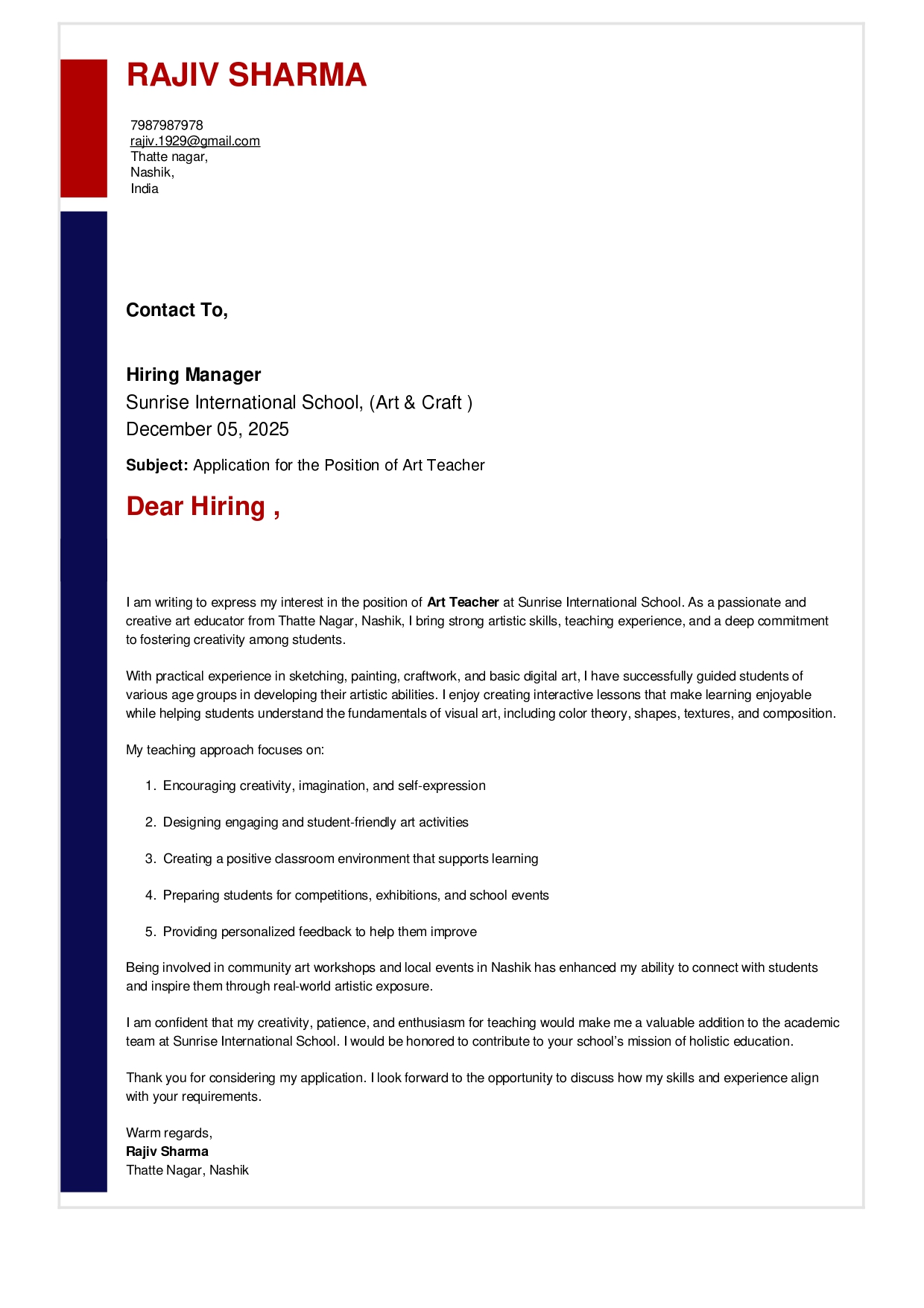
At the beginning of your cover letter, it is essential to incorporate a distinct header that reflects your professionalism and organizational skills. List your full name, location, phone number, and email address, each on a separate line. Following this, provide the date of your application submission along with a salutation to the reader. If you are unaware of the name of the person reviewing resumes, "Dear Hiring Manager" serves as an appropriate greeting. However, if you do know the name of this individual, you may directly address the letter to them by writing, "Dear [Full Name]" or "Dear Principal [Surname]."
3. Start with a good introduction line.
The initial complete paragraph of your letter serves as an excellent chance to present yourself and specify the position and organization for which you are applying. Clearly conveying this essential information at the outset of your letter can assist the hiring manager in maintaining organization. Following this, provide a summary of your pertinent professional experience and outline several reasons for your interest in this position or why you believe you are a suitable candidate for the school. It may be beneficial to employ enthusiastic language to foster a favorable first impression on the reader.
4. Explain why you are the right fit.
A well-written cover letter body should include paragraphs detailing why you are an ideal candidate for this role. You may wish to discuss your background as an educator, highlighting previous teaching roles, training, skills, and the age groups you feel most at ease working with. Additionally, you can elaborate on your experience as an artist, mentioning your art training, exhibitions, or your enthusiasm for teaching art. It may be beneficial to include particular achievements or career aspirations to provide more detail in your letter.
5. Closing line
The conclusion of a cover letter should include a brief summary. You may reiterate your application intentions and rationale, highlighting why you are a suitable candidate. Additionally, express gratitude to the reviewer for their time and encourage them to reach out with any further inquiries or feedback. If you possess a portfolio of artwork or a comparable professional website, consider including that link in your conclusion to facilitate the reader's exploration of your background and work. End with a courteous closing and your complete name.
Key Takeaways for an Art Teacher Cover Letter
- Craft a customized cover letter for an art teacher, which includes the employer’s name in the salutation.
- Format the cover letter with single spacing only, margins of 1 inch, and modern ATS-friendly fonts.
- The starting of your cover letter should always showcase the thing that is most important about your application.
- Your cover letter for art teacher position should always shows your topmost achievements and job relevant skills.
Common mistakes to avoid in your cover letter
- Not tailoring the cover letter for art teacher role.
- Using too much general language and phrases.
- Frequent typing and grammar mistakes.
- Including unnecessary details.
- Writing a very long cover letter.
- Not mentioning your reachable information.
- Failing to address the cover letter to the right person.
- Not adding a line on why you are the right fit for the role.
- Not writing a CTA.
Final Thoughts
Still have confusion on how to write a perfect art teacher job cover letter? Don’t worry, your confusion ends right here. JobsCruze is your trusted partner for creating customized cover letters. Our AI-powered cover letter writers save you time and give you improved quality cover letters. Now you can customize your cover letter with the specific job effortlessly. So, don’t miss out on this opportunity to make your job application stand out. Sign up for JobsCruze today.
Art Teacher Cover Letter FAQ’s
Q1. What is the best way to start my art teacher’s cover letter?
A. Start with a good introduction that explains the job you’re applying for and showcases your eagerness and capabilities.
Q2. What are the skills that I should highlight in my Art Teacher’s cover letter?
A. Highlight the experience you have in teaching, expertise in art, and skills to inspire the young minds.
Q3. How long should my art teacher's cover letter be?
A. Focus on one page, keeping it short, simple to understand, and achievement-focused.
Q4. Can I write an art teacher cover letter with no experience?
A. Yes, highlight your education, your passion for art, and any experience related to internships.
Q5. How to conclude an art teacher’s cover letter?
A. Show your enthusiasm for the interview, and say thank you to the hiring person with a professional closing phrase.
