




Table of Contents
▼- Civil Engineering Cover Letter Examples & Writing Guide
- What constitutes a civil engineer cover letter for job application?
- 1. Cover Letter Header
- 2. Cover Letter Salutation
- 3. Cover Letter Introduction
- 4. Cover Letter Body
- 5. Cover Letter Conclusion
- How to write a civil engineer cover letter with no experience?
- Cover letter writing mistakes to avoid
- Final Thoughts
- Frequently asked questions on writing a sample cover letter for job application for civil engineer.
- Q. What is the role of a cover letter for a civil engineer?
- Q. What is the ideal length of a cover letter?
- Q. How detailed should the cover letter be?
- Q. What is the most effective way to begin a Civil Engineer cover letter?
Civil Engineering Cover Letter Examples & Writing Guide
Crafting a compelling Cover letter for civil engineer involves more than merely outlining your qualifications and experiences. For Civil Engineers, the way you convey these details is crucial, as it reflects your planning, organizational, and project management abilities. This is where the structure of your cover letter becomes essential. A well-organized cover letter not only captures the attention of hiring managers but also demonstrates your precision and meticulousness—qualities that are highly regarded in Civil Engineering positions.
What constitutes a civil engineer cover letter for job application?
A civil engineer cover letter is a formal document that a candidate presents when applying for a position, highlighting their appropriateness for a civil engineering or construction job. It emphasizes the candidate's experience, professional achievements, and skills, while also expressing their enthusiasm for the role. An impactful cover letter generally highlights your work history as a civil engineer or in a related field, along with your pertinent skills, such as communication, technical expertise, teamwork, and project management.
Each section is essential in showcasing your professionalism and fit for the position. Let us analyze each section separately and highlight what you should prioritize to ensure your cover letter is distinctive.
1. Cover Letter Header
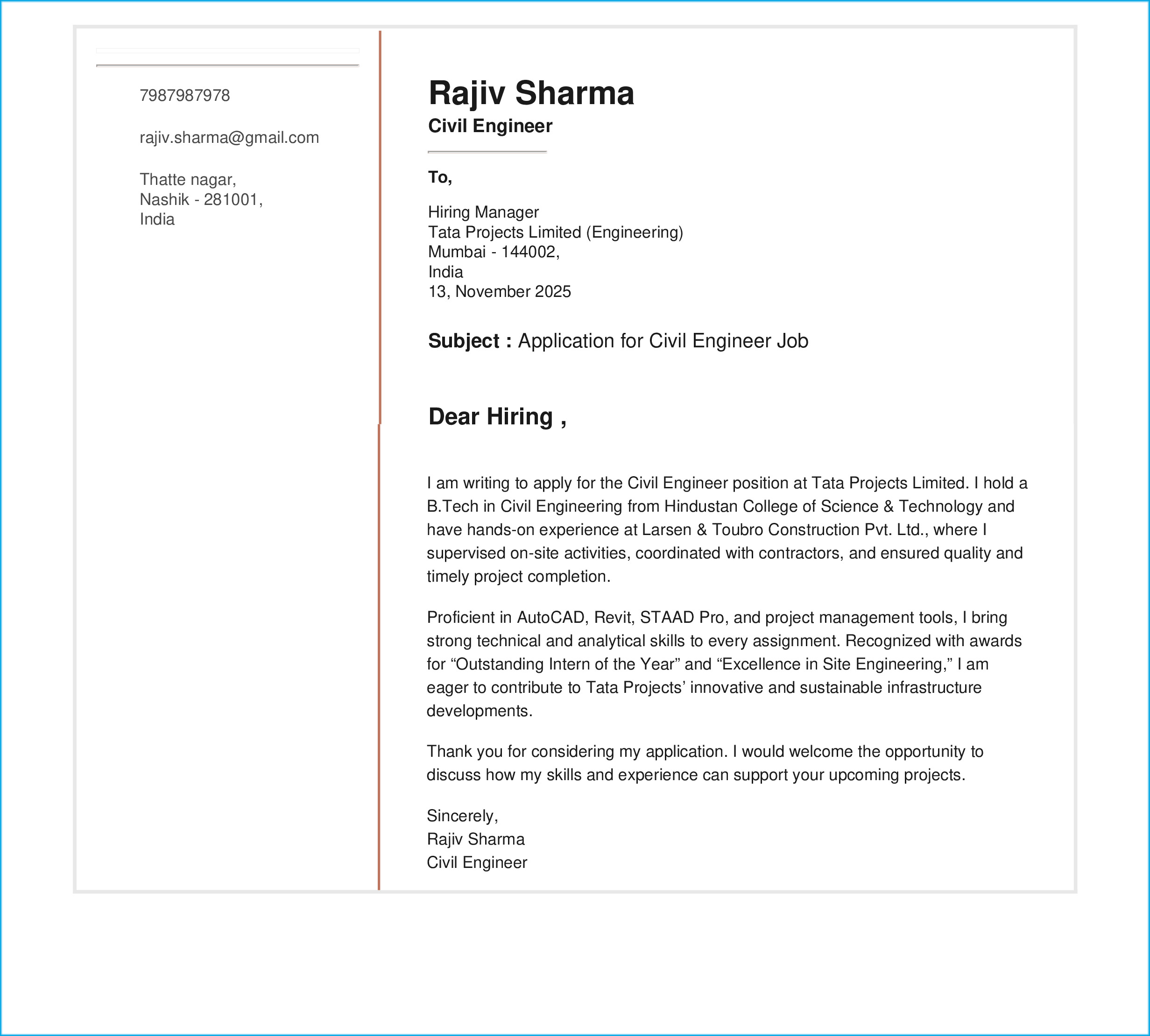
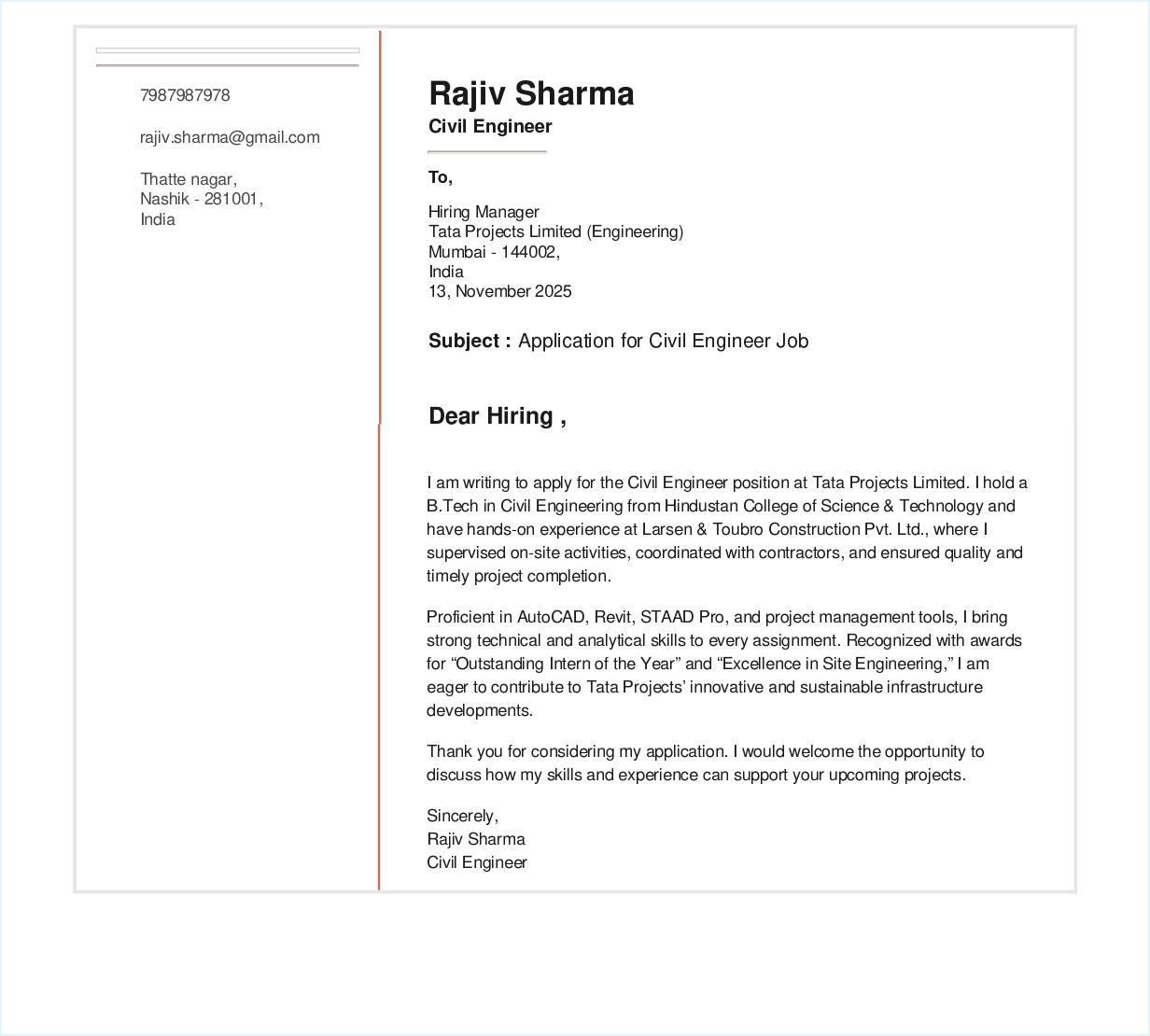
The header of your cover letter is the initial segment that presents vital contact details about yourself. It generally comprises your name, address, phone number, and email address. This part is significant as it enables the hiring manager to identify you and understand how to reach you.
As a Civil Engineer, it is important to ensure that your cover letter header is straightforward, succinct, and professional. Refrain from using elaborate fonts or colors; rather, opt for a simple, clean layout. Make sure to include your professional email address and a phone number where you can be readily contacted. If you possess a LinkedIn profile or a professional website, it may be beneficial to include those as well.
2. Cover Letter Salutation
The salutation in your cover letter serves as the initial introduction, establishing the tone for the remainder of your correspondence. It constitutes the first impression you create for your prospective employer and fulfills the role of showcasing your professionalism and respect for the individual you are addressing.
Refrain from using generic salutations such as "To Whom It May Concern" or "Dear Sir/Madam". Instead, strive to discover the name of the hiring manager or the individual who will be reviewing your letter. If you are unable to locate a specific name, consider using a job title such as "Dear Hiring Manager" or "Dear Engineering Department". This indicates that you have invested time in customizing your application to the particular role and organization, which can distinguish you from other applicants.
3. Cover Letter Introduction
The introduction of your cover letter, also known as the opening paragraph, presents your initial chance to create a lasting impression on a prospective employer. This segment is vital as it establishes the tone for the remainder of your letter, serving as your opportunity to capture the reader's interest. For Civil Engineers, this may involve referencing a significant project you have been involved in, or a particular skill or certification that aligns with the job requirements.
Civil Engineers should craft their opening paragraph with a clear and succinct message. Begin by specifying the Civil Engineer position you are applying for, along with your reasons for your interest in it. Subsequently, emphasize one or two key qualifications or experiences that position you as an outstanding candidate for the role. Therefore, ensure that your introduction is both engaging and pertinent.
4. Cover Letter Body
The body of your cover letter is the core of your job application as a Civil Engineer. It provides you with the chance to demonstrate your qualifications, experiences, and skills that position you as the ideal candidate for the role. In this section, you can present specific examples of your work, emphasize your accomplishments, and articulate how you can contribute to the success of the company.
As a Civil Engineer, your cover letter body should emphasize your technical skills and project experiences. Showcase your expertise in utilizing engineering software, your understanding of civil engineering principles, and your capability to manage projects efficiently. Keep in mind that your objective is to persuade the hiring manager that you are the most suitable candidate for the position.
5. Cover Letter Conclusion
The cover letter conclusion paragraph, or the final paragraph, represents your last chance to make a memorable impact on the hiring manager. It acts as the culmination of your argument for why you are the ideal candidate for the Civil Engineer position. This part should concisely summarize your credentials, reaffirm your enthusiasm for the role, and convey your willingness to contribute to the company's objectives. Additionally, it is the appropriate moment to express gratitude to the hiring manager for their time and consideration, as well as to indicate your availability for further discussions or an interview.
Civil Engineers should approach their cover letter conclusion with an emphasis on professionalism and enthusiasm. It is also crucial to conclude with a compelling call to action, such as a request for an interview or a statement indicating your intention to follow up. Keep in mind that the conclusion of your cover letter should provide the hiring manager with a clear understanding of your qualifications and a strong motivation to learn more about you.
How to write a civil engineer cover letter with no experience?
The most valuable guidance for candidates crafting their entry level civil engineering cover letter is straightforward - maintain honesty. In the absence of professional roles in your background, direct the attention of recruiters towards your strengths - such as your distinctive, transferable skill set (acquired throughout your life), supported by a significant achievement.
Alternatively, if you possess grand aspirations and a strong desire to become part of the company, utilize your civil engineer cover letter to articulate your career ambitions - the ones that inspire you to stay awake at night, envisioning your future. Lastly, always make certain that you have addressed why employers should select you specifically and how your skills would contribute positively to their organization.
Cover letter writing mistakes to avoid
- Neglecting to Emphasize Pertinent Skills and Experience
- Failing to customize the cover letter for a civil engineering job
- Excessive Use of Technical Terminology
- Disregarding Interpersonal Skills
- Omitting Proofreading
Final Thoughts
Advance your career with a cover letter that distinguishes you from the competition. Utilize the JobsCruze Cover Letter Builder to swiftly craft a refined, ATS-compatible cover letter within minutes. Click here to construct your professional cover letter today and enhance your likelihood of securing employment with JobsCruze!
Frequently asked questions on writing a sample cover letter for job application for civil engineer.
Q. What is the role of a cover letter for a civil engineer?
A. The role of a cover letter is to emphasize your distinct skills and experiences that position you as an excellent candidate for the civil engineering role. It should not merely repeat your resume, but rather tell a story that illustrates why you are the most suitable applicant.
Q. What is the ideal length of a cover letter?
A. It is typically advisable to keep your cover letter succinct and targeted, ideally limited to three or four paragraphs. Including excessive information may cause the reader to lose interest before they have fully absorbed your message. A short yet impactful cover letter helps maintain the hiring manager's focus on your most significant engineering achievements and qualifications.
Q. How detailed should the cover letter be?
A. Your cover letter ought to offer enough detail for the hiring manager to comprehend what you contribute beyond your resume. Nevertheless, it should remain concise and focused preferably not exceeding one page.
Q. What is the most effective way to begin a Civil Engineer cover letter?
A. The most effective way to begin a Civil Engineering cover letter is to directly address the hiring manager, if their name is available. Following that, introduce yourself and specify the position for which you are applying. Promptly highlight your most pertinent experience or accomplishment that corresponds with the job requirements.
