




Table of Contents
▼- Aeronautical Engineering Cover Letter Examples & Writing Guide
- What is an aeronautical engineer?
- Format of an aeronautical engineer cover letter
- 1. Cover Letter Header
- 2. Cover Letter Greeting
- 3. Cover Letter Introduction
- 4. Cover Letter Body
- 5. Cover Letter Closing
- Cover Letter Writing Tips for Aeronautical Engineers
- Common Mistakes to Avoid When Writing an Aeronautical Engineer's Cover Letter
- Final Thoughts
- Aeronautical engineering FAQ’s
- Q. What tone and language should I employ in my aerospace engineer cover letter?
- Q. How long should my aeronautical engineer cover letter be?
- Q. How can I personalize my cover letter for aeronautical engineer job requirements?
- Q. Should I mention any specific aeronautical engineering projects or companies I admire in my cover letter?
Aeronautical Engineering Cover Letter Examples & Writing Guide
If you're interested in becoming an aeronautical engineer, submitting well-written application documents can help you highlight your credentials and demonstrate why you're the right candidate for the role. A cover letter allows you to elicit a more in-depth discussion of your experience and training and highlight why you're pursuing this career. Understanding what a hiring manager is looking for in a prospective employee can help you distinguish yourself from other candidates and secure an interview. In this article, we will discuss what to include in a cover letter for aerospace engineer, describe how to write one, and provide a template and example to guide you.
What is an aeronautical engineer?
An aeronautical engineer is an aerospace engineering professional who designs and oversees the manufacturing, construction and upkeep of aircraft and missiles. They primarily design these mechanisms and machines for government, commercial or military use. Aeronautical engineer responsibilities include ensuring their designs meet safety and environmental requirements and performing aircraft inspections to identify areas that require maintenance or improvement.
Format of an aeronautical engineer cover letter
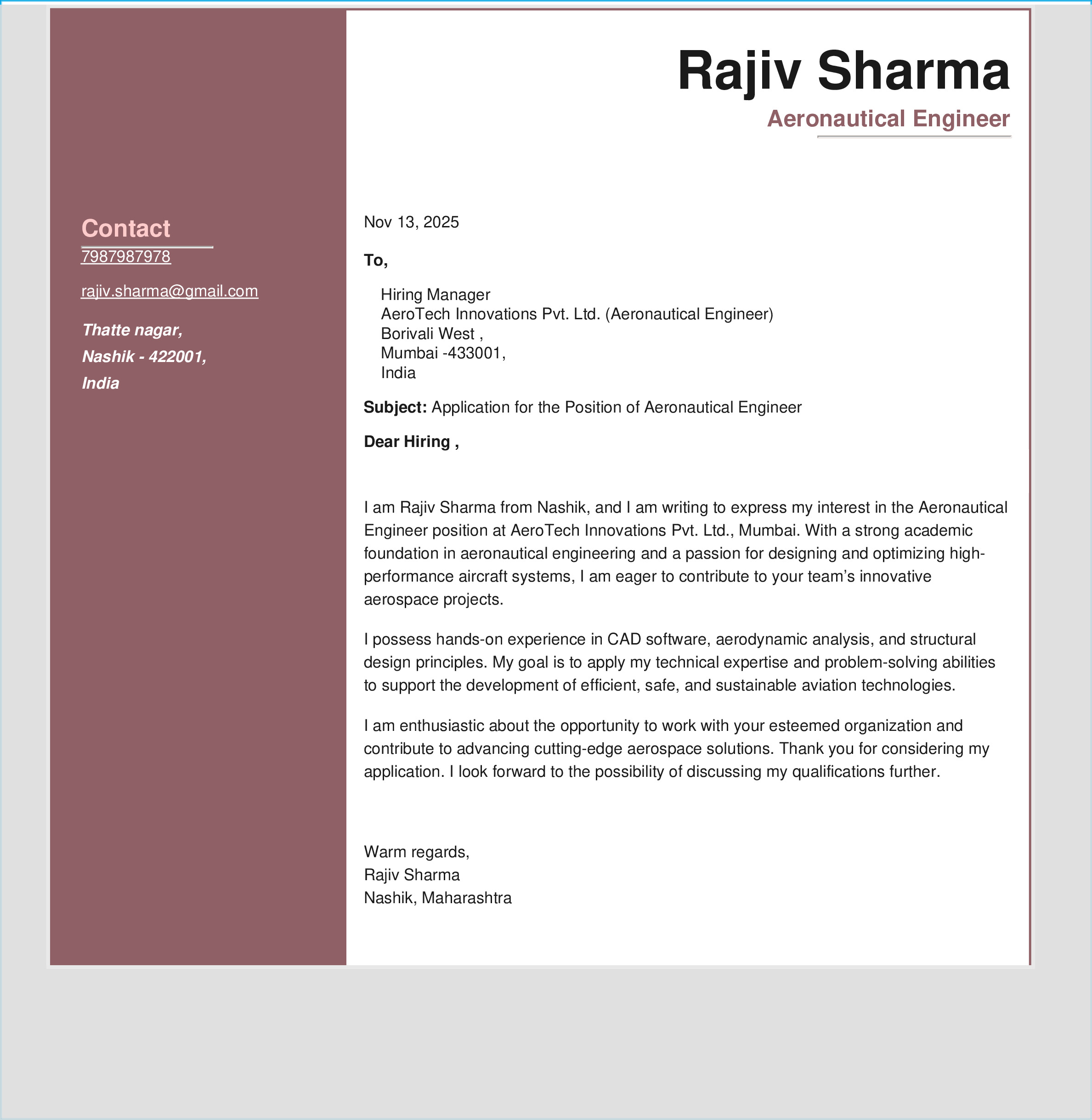
1. Cover Letter Header
The cover letter header is the first section of your cover letter that provides essential contact information about you, the job applicant. It typically includes your name, address, phone number, and email address. It may also include your LinkedIn profile or professional website if applicable. The purpose of the cover letter header is to ensure that the hiring manager or recruiter can easily identify and contact you. It sets the professional tone for the rest of your cover letter and should be clear, concise, and error-free.
2. Cover Letter Greeting
The cover letter greeting is the initial introduction in your letter, setting the tone for the rest of your communication. It's the first impression you make on the hiring manager, and it's an opportunity to show respect and professionalism. The purpose of a professional cover letter greeting is to acknowledge the recipient and to establish a connection right from the start. It's a small but significant part of your cover letter that can either engage the reader or turn them off.
3. Cover Letter Introduction
The cover letter introduction, or opening paragraph, is your first opportunity to make a strong impression on a potential employer. It's the section where you introduce yourself, express your interest in the position, and briefly explain why you're a suitable candidate. The purpose of the eye-catching cover letter introduction is to grab the reader's attention and encourage them to read the rest of your cover letter.
4. Cover Letter Body
The cover letter body paragraph, or main content, is the heart of your cover letter. It's where you get to showcase your skills, experiences, and passion for the field of aeronautical engineering. The purpose of this section is to convince the hiring manager that you are the best candidate for the job. It's your chance to highlight your achievements, explain how you can contribute to the company, and demonstrate your understanding of the role and the industry.
5. Cover Letter Closing
The cover letter closing is your final opportunity to leave a lasting impression on the hiring manager. This section of your cover letter is where you reiterate your interest in the position, express your enthusiasm for the company, and provide a call to action for the next steps. It's a crucial part of your cover letter as it sums up your aeronautical engineer qualifications and shows your eagerness to contribute to the company.
Cover Letter Writing Tips for Aeronautical Engineers
- Highlight Relevant Skills and Experience
- Showcase Your Problem-Solving Abilities
- Express Your Passion for Aeronautics
- Emphasize Your Teamwork Skills
- Customize Your Cover Letter for Each Job
Common Mistakes to Avoid When Writing an Aeronautical Engineer's Cover Letter
- Using a generic cover letter: Employers can tell when a letter isn't personalized. A generic cover letter lacks the specific details that show your genuine interest in the role and the company, making it less compelling.
- Overloading with technical jargon: Keep it understandable and relevant. While technical skills are important, overloading your cover letter with jargon can make it difficult to read and may alienate non-technical hiring managers.
- Not tailoring the letter to the job and company: Show that you've done your research. Tailoring your cover letter demonstrates that you understand the company's needs and how your skills and experiences align with their goals.
- Failing to highlight achievements: Specific examples make your application stand out. Highlighting your achievements with concrete examples shows your impact and effectiveness, making your application more memorable.
- Neglecting to proofread: Errors can reflect poorly on your attention to detail. Spelling and grammar mistakes can undermine your professionalism and suggest a lack of care, which is critical in a detail-oriented field like aeronautical engineering.
Final Thoughts
Advance your career with a cover letter that distinguishes you from the competition. Utilize the JobsCruze Cover Letter Builder to swiftly craft a refined, ATS-compatible cover letter within minutes. Click here to construct your professional cover letter today and enhance your likelihood of securing employment with JobsCruze!

Aeronautical engineering FAQ’s
Q. What tone and language should I employ in my aerospace engineer cover letter?
A. Nailing the right tone of your cover letter is all about sounding professional yet engaging. Try to avoid overly formal language and jargon, and instead, communicate your enthusiasm for the position and industry in clear and confident language. But be careful and don't overdo it!
Q. How long should my aeronautical engineer cover letter be?
A. Ideally, your cover letter shouldn’t exceed one page in length. Aim for 3-4 body paragraphs accompanied by one introductory and one closing paragraph. And, always keep your writing focused on relevant qualifications and experiences.
Q. How can I personalize my cover letter for aeronautical engineer job requirements?
A. First of all, you need to do a fair bit of digging. Research the company and job role to understand the employer's needs and culture. Then, use this information to your advantage and tailor your cover letter to highlight how your aeronautical engineering skills and experiences align with the specific requirements of the position and demonstrate your enthusiasm for contributing to the company's goals.
Q. Should I mention any specific aeronautical engineering projects or companies I admire in my cover letter?
A. Of course you should! Mentioning specific aerospace projects or companies you admire can demonstrate your genuine interest in the industry and your awareness of key players and innovations. However, ensure that your references are relevant to the job you're applying for and tie them back to your own experiences and aspirations as an aeronautical engineer.
