




Table of Contents
▼- Corporate Lawyer Cover Letter Example & Writing Guide
- Steps of writing a corporate lawyer cover letter
- Essential cover letter tips
- FAQ’s on corporate lawyer cover letter
- Q. What is the appropriate length for a corporate lawyer's cover letter?
- Q. Should I refer to the recruiter by name in my letter?
- Q. How should I finalize my cover letter for a corporate lawyer position?
- Q. Is a cover letter essential if it is not specifically requested?
- Q. Is it permissible to incorporate bullet points in my cover letter?
Corporate Lawyer Cover Letter Example & Writing Guide
A meticulously composed cover letter for a Corporate Lawyer can distinguish you in the highly competitive legal sector. Employers are in search of individuals who possess knowledge in corporate governance, contract law, mergers and acquisitions, regulatory compliance, and risk management. Your cover letter ought to emphasize your background in corporate law, your negotiation abilities, and your capacity to provide legal counsel to businesses. Below are customizable tips for writing a Corporate Lawyer cover letter to assist you in creating a compelling job application.
Steps of writing a corporate lawyer cover letter
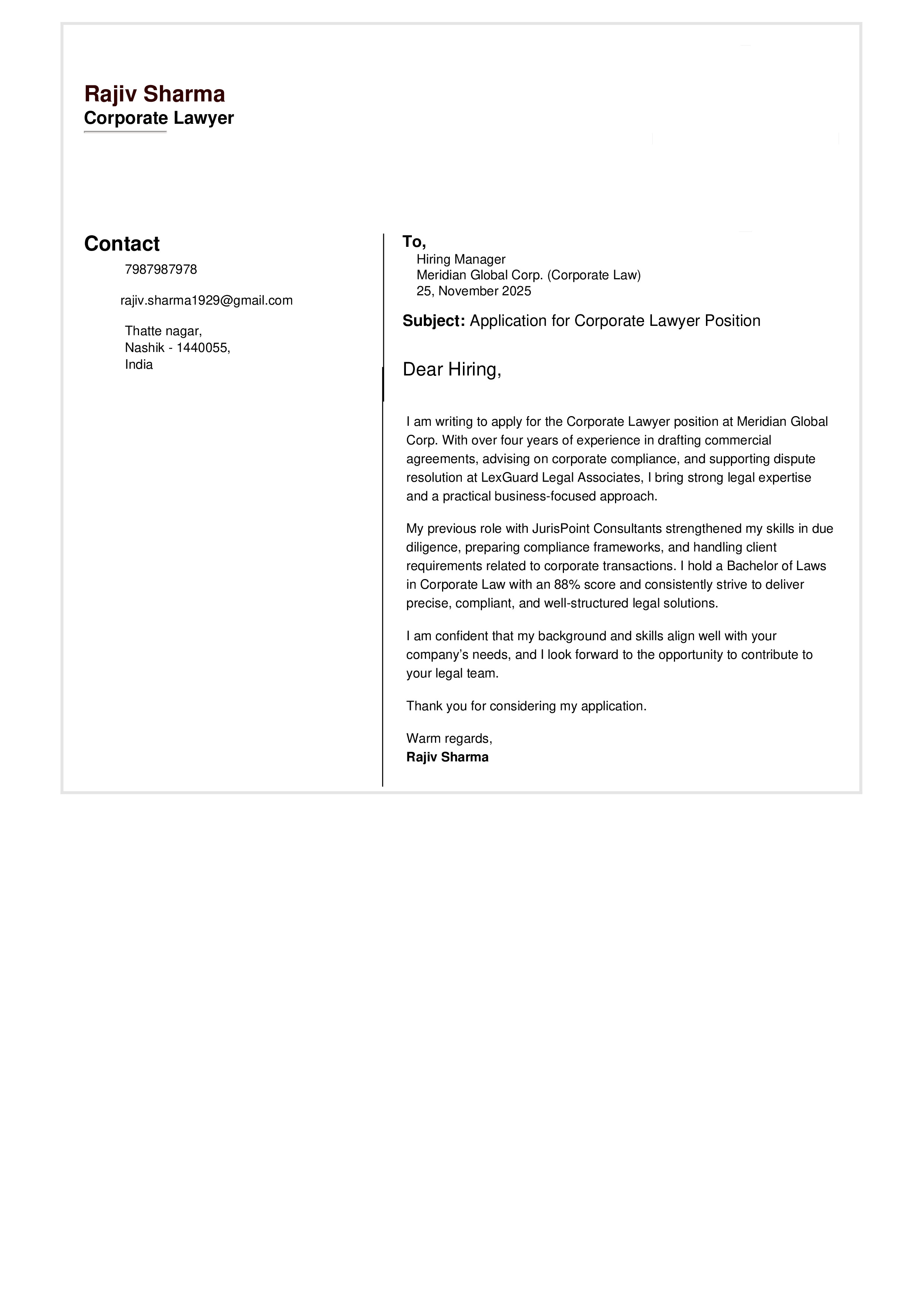
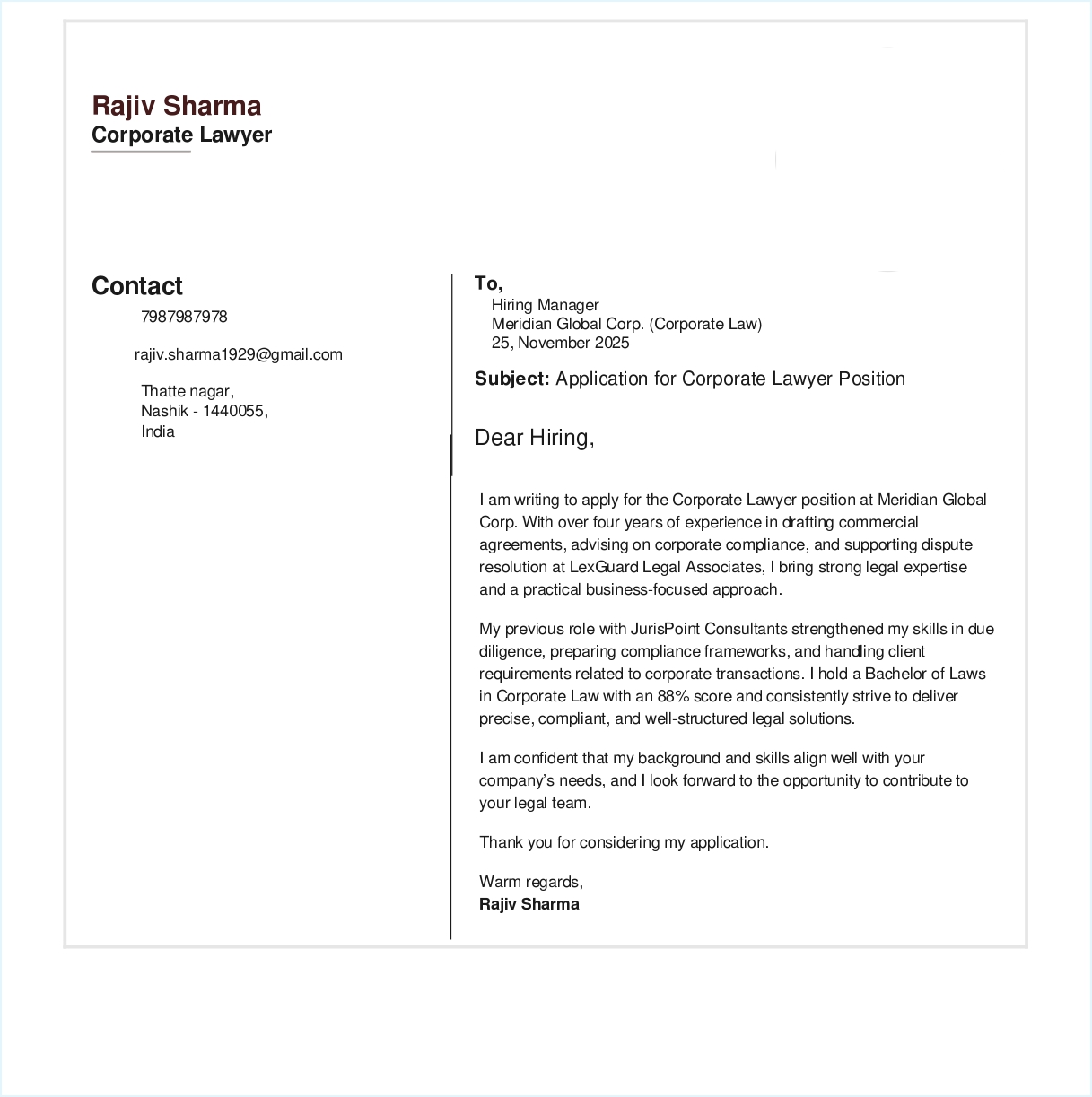
1. Your contact details and salutation
In the header of your corporate attorney cover letter, include your name, phone number, email address, and LinkedIn profile URL. Ensure that you address the hiring manager by their name — Mr. or Ms. [Last Name]. If you are unable to locate the hiring manager’s name, opt for a variation of "Dear Hiring Manager." This is more favorable than salutations like "To Whom It May Concern," as this phrasing is more direct and personal.
2. Introduction paragraph
The opening of your cover letter for corporate lawyer serves as your initial opportunity to captivate the hiring manager by highlighting your distinctive legal experience. Focus the introductory paragraph on one of your most significant career accomplishments. Select an achievement that can be quantified, such as the total number of cases you have managed or the average monetary value of the settlements you have secured. This effectively illustrates the nature of the legal challenges you have faced previously and demonstrates why you are the perfect fit for the role.
3. Main body paragraph
Elaborate your professional accomplishments and legal background in the main sections of your lawyer cover letter. Begin by emphasizing particular aspects of the firm's reputation or values and how they correspond with your experience. Highlight your distinct areas of legal specialization, including family, corporate, civil, or criminal law. Present quantifiable data to convey the extent of the cases you have managed during your career. Additionally, illustrate your capacity to communicate proficiently with clients, opposing counsel, and other legal entities.
4. Closing statement
Ensure that your conclusion persuades the hiring manager of your capabilities and generates interest in inviting you for an interview. It should foster confidence in your qualifications and dispel any uncertainties regarding your suitability for the position. The conclusion of a cover letter is an opportunity to encapsulate your key legal competencies and explain why you would be an excellent addition to their team. Lastly, when you conclude, maintain a professional tone. Finish with a straightforward sign-off followed by your complete name.
Essential cover letter tips
-
Match your resume - Ensure that your cover letter visually aligns with your resume as closely as it does in terms of content quality. This will demonstrate your attention to detail and organizational skills.
- Highlight your achievements - Emphasizing your accomplishments is not merely an act of self-promotion; it serves to demonstrate the concrete outcomes of your commitment and skill.
- Mention relevant links - Incorporating pertinent links within your cover letter serves as an invitation for hiring managers to enter your professional realm. These links provide a more engaging view of your achievements, whether they are published articles, significant cases, or a meticulously organized LinkedIn profile.
FAQ’s on corporate lawyer cover letter
Q. What is the appropriate length for a corporate lawyer's cover letter?
A. A corporate lawyer's cover letter should ideally range from half a page to a full page, with a maximum word count of approximately 400 words. It is essential to maintain conciseness and focus in your letter, addressing only the experiences and skills pertinent to the position.
Q. Should I refer to the recruiter by name in my letter?
A. Indeed, it is generally advised to address the recruiter by name in your cover letter. This practice not only demonstrates that you have invested time in researching the individual you are communicating with, but it also adds a personal element to your letter. If you are unable to locate the recruiter's name, 'Dear hiring manager' serves as an appropriate substitute.
Q. How should I finalize my cover letter for a corporate lawyer position?
A. The closing section of your corporate lawyer cover letter ought to encapsulate the reasons you are well-suited for the position, convey your eagerness for a follow-up discussion regarding your application, and conclude with appreciation for the opportunity to be considered.
Q. Is a cover letter essential if it is not specifically requested?
A. Although a cover letter may not always be required, it is generally advisable to include one when applying for a corporate lawyer position. A thoughtfully crafted cover letter allows you to demonstrate your qualifications and abilities in a narrative format and assists the hiring manager in comprehending how you might add value to their organization beyond the details provided in your resume.
Q. Is it permissible to incorporate bullet points in my cover letter?
A. Although a cover letter is typically structured as a formal letter, using bullet points in cover letter in suitable contexts can effectively highlight significant points or accomplishments. Nevertheless, an excessive use of bullet points may render the letter fragmented. In most cases, a narrative approach is favored when detailing your experiences and skills.
