




Table of Contents
▼- Cybersecurity Specialist Cover Letter Examples & Writing Guide
- Steps for writing a cybersecurity specialist cover letter
- 1. Go through the Job Description carefully.
- 2. Choose the right format.
- 3. Start with a well-crafted paragraph.
- 4. Show your work experience.
- 5. Explain how you are the right fit for the position.
- 6. Conclude everything in a polite tone.
- 7. Proofread Everything
- Common mistakes in a cover letter
- Best practices for writing a cybersecurity specialist cover letter
- Cybersecurity Specialist cover letter FAQ’s
- Q. What Should Be Included in a Cover Letter for an Entry-Level Cybersecurity Position?
- Q. What is the best way to conclude your cybersecurity specialist cover letter?
- Q. How long should a Cybersecurity specialist's cover letter be?
Cybersecurity Specialist Cover Letter Examples & Writing Guide
Cybersecurity experts are essential to protecting an organization's data and digital assets in the digital era. Their proficiency in spotting weaknesses, reducing dangers, and handling security events is crucial for preserving the privacy and integrity of sensitive data. Recruiters and hiring managers are looking for cybersecurity candidates who exhibit strategic thinking, problem-solving abilities, and a clear awareness of the always changing threat landscape, in addition to having a deep technical understanding.
Cybersecurity professionals may demonstrate their abilities, leave a lasting impression, and land a desired interview opportunity with a well-written cover letter. This tutorial will assist you in creating a remarkable cover letter that promotes your candidacy and goes well with your CV.
Steps for writing a cybersecurity specialist cover letter
1. Go through the Job Description carefully.
Before starting your cover letter, read the job description. Look for keywords as well as the qualifications, experience, and abilities needed for the position. By adding these to your resume and cover letter, you can make your application stand out to the hiring manager. Additionally, keywords can help your application get past any automatic screening procedures in the software used by applicant tracking systems.
2. Choose the right format.
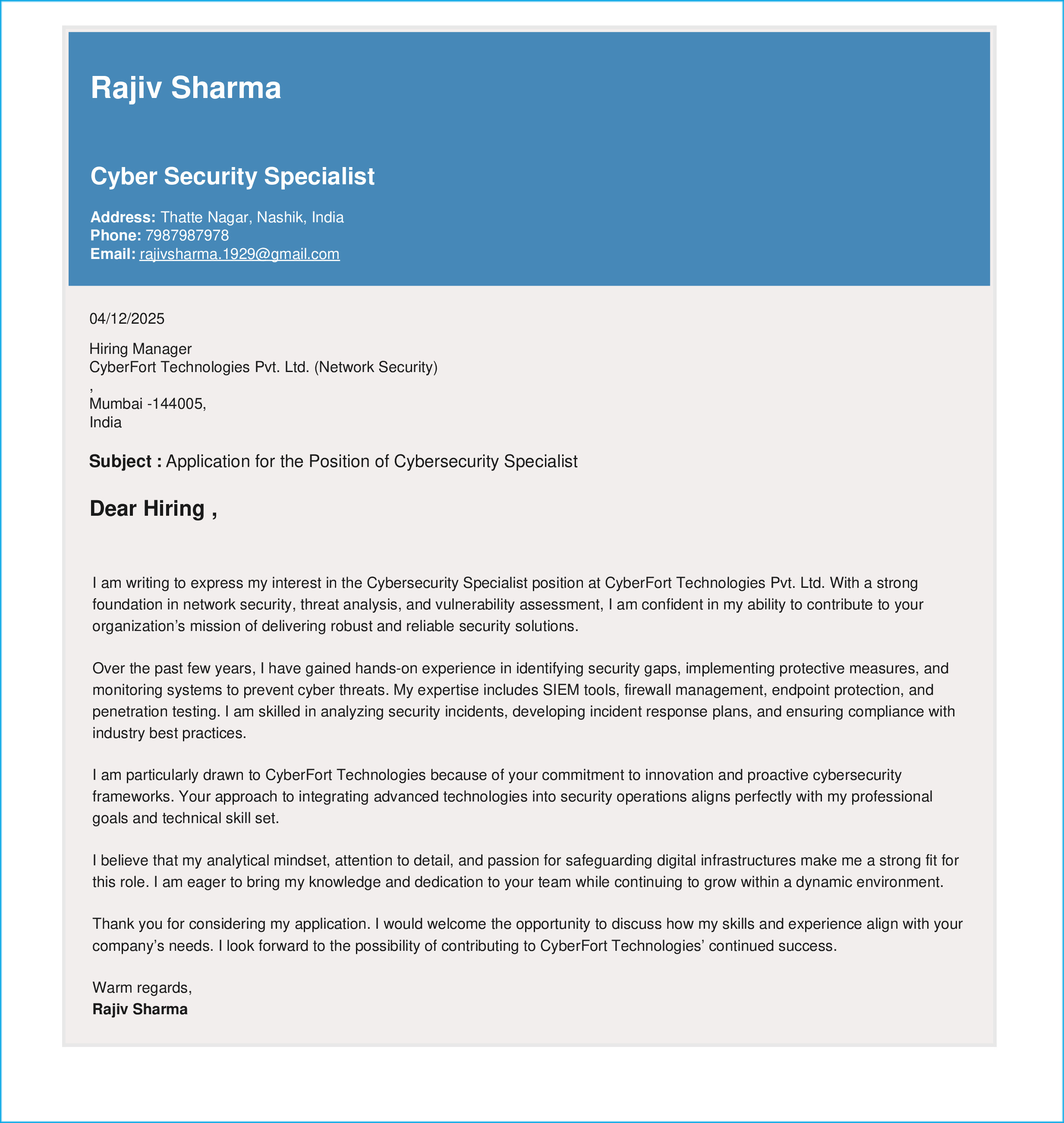
Choose a suitable margin to maintain your cover letter's professionalism and readability. On your resume, you can match the font and size, but make sure it's readable, like Times New Roman. Traditionally, cover letters are formatted like business letters. You can start by putting your address in the upper left corner, then the date, and finally the name and address of the company's hiring executive, recruiter, or job posting.
Related: Click on the link to get more tips on writing a cover letter and to make it standout.
3. Start with a well-crafted paragraph.
Make sure your greeting is professional. Find out the recipient's preferred professional title by doing some research before addressing them by their preferred name. Add a phrase or two about yourself after mentioning the title of the open position and where you found it. The introduction of your cover letter offers a chance to introduce yourself and highlight the most significant elements of your experience and abilities, much like the professional goal or summary at the beginning of your resume.
4. Show your work experience.
Explain your work experience in the second paragraph. Give a brief overview of your duties and achievements in your current role. Provide specifics about your job experience, including the operating systems you are familiar with, any cybersecurity certifications you may hold, and any tools you have utilized. If you recently graduated, you could discuss coursework or projects you've done that relate to the position. Using keywords from the job posting is OK here.
5. Explain how you are the right fit for the position.
Make a connection between your experience and how you think you can benefit the firm in the third paragraph. Along with outlining particular procedures or methods, you can also discuss how your soft skills contribute to your success at work. For example, you can highlight your communication skills if the job description calls for generating security training for staff members or creating reports. If the business is actively growing, you might also highlight any of your non-job-related abilities that you think the organization would find useful, such as your knowledge of setting up more secure data storage or integrating new mobile devices.
6. Conclude everything in a polite tone.
Try to provide the reader with a positive sense of your professionalism at the end. To ensure they can readily comprehend your email attachments or submitted application, thank them for their time and make a note of the documents you attach. After using a formal closure, provide your name.
7. Proofread Everything
Before sending in your letter, proofread it for correct figures, grammar, spelling, and punctuation. For cybersecurity experts, a neat letter demonstrates your attention to detail, which is crucial. Make sure the name and address of each organization are correct at the top and throughout the letter, especially if you are sending out many applications.
Common mistakes in a cover letter
- Submitting the same generic cover letters for various job applications, failing to customize or adjust the address or content.
- Excessive wordiness, redundancy, meandering discourse, empty clichés, and unnecessary filler language.
- Placing too much emphasis on technical skills while neglecting communication and interpersonal abilities.
- Avoidable and fixable typographical errors, spelling inaccuracies, and grammatical mistakes.
- Dependence on spell-check and grammar applications that do not identify other issues, such as inconsistent capitalization, periods at the end of bullet points, and variations in date formats.
Best practices for writing a cybersecurity specialist cover letter
-
Research thoroughly about the company you are applying to and its organizational culture.
-
A cover letter should not exceed one page, necessitating careful selection of the skills and experiences you wish to emphasize.
-
Each letter you compose must be customized specifically for the job position you are pursuing.
- Attention to detail is crucial for any specialist in Information Security or Cybersecurity.
Cybersecurity Specialist cover letter FAQ’s
Q. What Should Be Included in a Cover Letter for an Entry-Level Cybersecurity Position?
A. To begin your cover letter for an Entry Level Cybersecurity role, it is advisable to address the hiring manager directly, if feasible. In the event that you are unaware of their name, using "Dear Hiring Manager" is a suitable alternative. Following this, introduce yourself and specify the position for which you are applying. Additionally, be sure to indicate where you discovered the job listing.
Q. What is the best way to conclude your cybersecurity specialist cover letter?
A. The most effective method for entry-level cybersecurity professionals to conclude a cover letter is to convey appreciation for the reader's time and consideration, restate their enthusiasm for the position, and express willingness for further dialogue.
Q. How long should a Cybersecurity specialist's cover letter be?
A. A cover letter intended for a cybersecurity specialist position should typically be approximately one page in length. This duration is adequate to present yourself, articulate your interest in the cybersecurity sector and the particular role, emphasize your pertinent skills and experiences, and finish with a compelling closing statement.
