


Table of Contents
▼- Web Designer Cover Letter Samples & Writing Guide
- How to Craft a Sample cover letter for a web developer position?
- Guidelines for Composing a cover letter for a web designer
- Common Errors to Avoid When Composing a Web Designer Cover Letter
- Final Thoughts
- Web developer cover letter sample FAQ’s
- Q. What is the most effective method to initiate a Website Designer cover letter?
- Q. How should Web Designers conclude a cover letter?
- Q. What is the ideal length for a Web Designer's cover letter?
- Q. Is it advisable to utilize artificial intelligence for writing my cover letter?
Web Designer Cover Letter Samples & Writing Guide
Crafting a compelling cover letter requires more than merely highlighting your technical expertise as a Web Designer. The manner in which you convey your skills of web developer, experiences, and enthusiasm for web design can greatly affect a hiring manager's view of your application. This is why the layout of your cover letter is essential. A thoughtfully organized cover letter not only captures the interest of hiring managers but also demonstrates your creativity, meticulousness, and comprehension of user experience qualities that are greatly esteemed in the web design industry.
How to Craft a Sample cover letter for a web developer position?
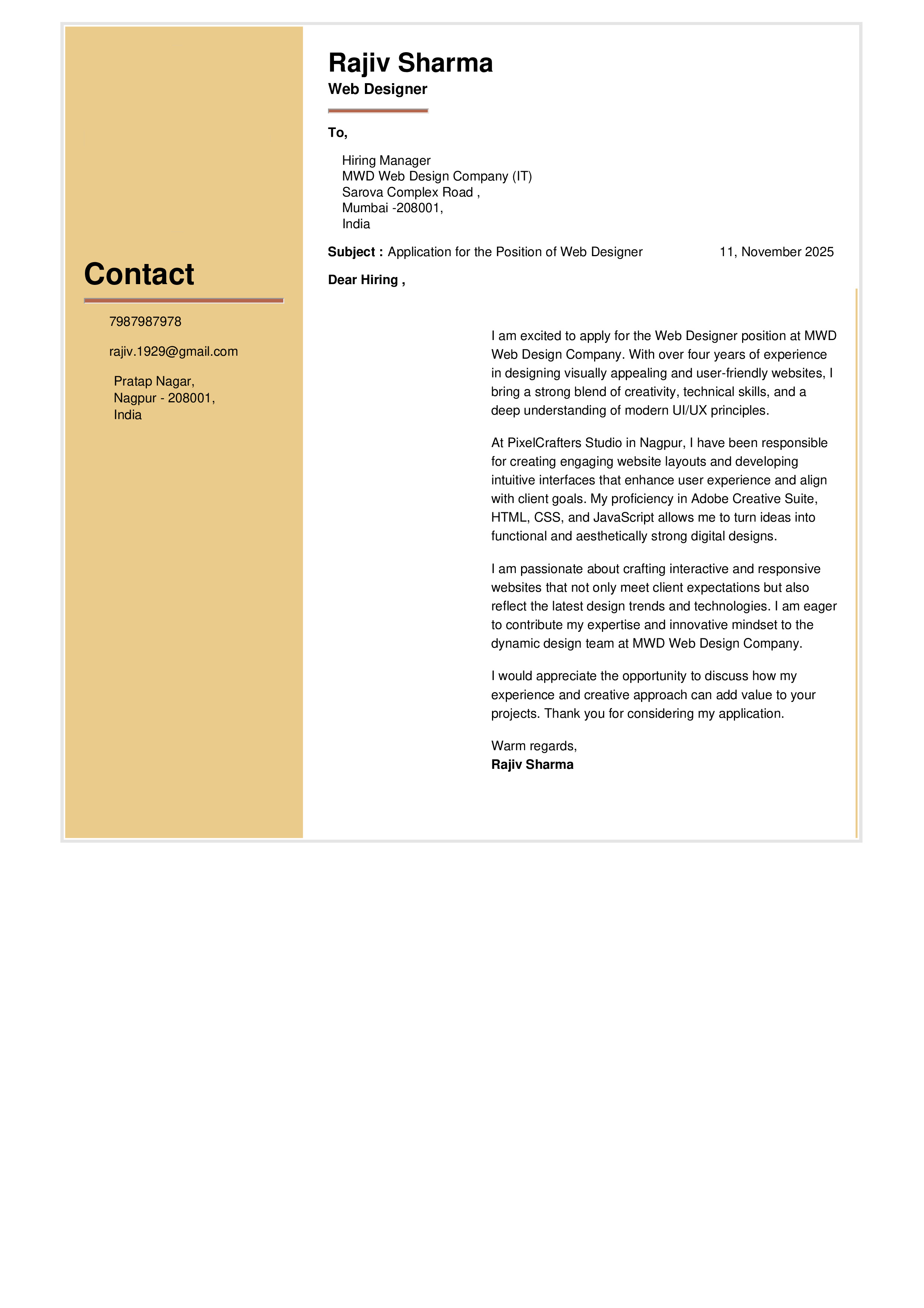
1. Add your contact details in the header
At the beginning of your cover letter, list your complete name, phone number, and email address. Following your contact details, include the current date. By placing your information in the header, you facilitate the process for recruiters to locate your details should they wish to reach out to you.
2. Salute your recipient
Using an appropriate salutation generally establishes the right tone for your website developer cover letter. For instance, it is advisable to begin with the word Dear followed by the hiring manager's name. If you cannot locate their name, you may opt for Dear Hiring Manager instead. To obtain the recruiter's information, you can refer to the job posting or the company's website.
3. Highlight your professional attributes
The opening paragraph serves as the introduction, aiming to capture the recruiter's interest. Begin this paragraph by stating the name of the company and the position you are applying for. Subsequently, provide a brief rationale for why you consider yourself the ideal candidate for the role and how your distinctive skills set sets you apart from other applicants. Adopting a straightforward approach enables you to articulate your intentions clearly, demonstrating that you respect the recruiter's time.
4. Outline your essential skills and achievements
In the second paragraph, clarify why you think you are the appropriate candidate for the position and detail the significant roles, measurable accomplishments, and positive contributions you made in your previous positions. Emphasizing your web developer key skills is an effective method to convey to the hiring manager that you are well-suited for the role. Offer several examples of your successes in a comparable position. Utilize this section to illustrate how your specific programming language expertise and knowledge could be advantageous to the hiring company.
Avoid reiterating information that is present on your resume. Instead, share particular experiences, narratives, or anecdotes that highlight your qualifications for the role. Discussing your professional journey may assist the employer in comprehending your capabilities. To enhance your chances of success, identify the keywords in the job description and incorporate them into your letter.
5. Articulate your desire to join the company
In this part, elaborate on your eagerness to work for the company, as the recruiter may wish to comprehend what inspired you to apply for the position. As recruiters seek candidates with strong work ethics and the ability to advocate for the organization, showcasing your enthusiasm and motivation may enhance your chances of success.
6. Provide a noteworthy conclusion to your letter
Conclude your cover letter with a powerful and memorable statement. Express gratitude to the recruiter for taking the time to review your letter and for the opportunity to apply for a position at the company. End your letter by indicating your eagerness to discuss your knowledge and skills, as well as the next steps in the hiring process.
To conclude your cover letter, utilize a professional closing. Common options include Best regards, Sincerely, and Thank you. Place a comma after the closing and write your name beneath it.
7. Proofread your cover letter
Prior to submitting your cover letter to the recruiter, meticulously proofread it several times to identify and rectify grammatical errors, spelling mistakes, awkward phrasing, and incorrect sentence structures. To assist in spotting errors, it may be beneficial to read your letter aloud or request a friend or colleague to review it. Before sending your cover letter and resume via email, confirm that the files are included and that the links are functional.
Additionally, it is advisable to limit your cover letter to a single page and 300 words. Since recruiters seldom examine each cover letter in detail, it is crucial to keep your letter concise and focused. Highlight your most significant achievements and incorporate key phrases and keywords that may attract the recruiter's attention.
Guidelines for Composing a cover letter for a web designer
- Emphasize your most impressive web design projects.
- Measure and present your experience as a web designer.
- Showcase your leadership abilities and technical expertise.
- Provide a link to your portfolio.
- Convey your enthusiasm for web design.
.jpg)
Common Errors to Avoid When Composing a Web Designer Cover Letter
When developing a cover letter, it is crucial to portray yourself in the most favorable manner to prospective employers. Nevertheless, there are frequent errors that may impede your ability to leave a lasting impression. By recognizing these common pitfalls and steering clear of them, you can guarantee that your cover letter effectively showcases your qualifications and differentiates you from other candidates.
Therefore, let us explore how to avoid these typical missteps and craft an exceptional cover letter that captures the attention of potential employers.
- Not conducting research on the company.
- Employing generic language
- Demonstrating a lack of enthusiasm
- Utilizing incorrect contact details
- Neglecting to address the specific job requirements
- Incorporating excessive irrelevant information
- Using a standard closing statement
- Including an abundance of typos and grammatical mistakes
- Failing to tailor the letter for each job application
- Not addressing the employer’s needs.
Final Thoughts
Advance your career with a cover letter that distinguishes you from the competition. Utilize the JobsCruze Cover Letter Builder to swiftly craft a refined, ATS-compatible cover letter within minutes. Click here to construct your professional cover letter today and enhance your likelihood of securing employment with JobsCruze!
Web developer cover letter sample FAQ’s
Q. What is the most effective method to initiate a Website Designer cover letter?
A. The most effective method to initiate a Web Designer cover letter is to capture the reader's interest with a compelling opening statement. This could include a concise expression of your enthusiasm for web design, a significant accomplishment, or an explanation of how you can address a challenge the company is encountering.
Q. How should Web Designers conclude a cover letter?
A. Web Designers should conclude a cover letter by reiterating their enthusiasm for the position and their assurance in contributing value to the company through their experience and skills required for a web developer.
Q. What is the ideal length for a Web Designer's cover letter?
A. A cover letter for web designer should ideally span approximately one page, or around 300-500 words. This length is adequate to introduce yourself, outline your skills and experience, and convey your interest in the role without overwhelming the reader with excessive information.
Q. Is it advisable to utilize artificial intelligence for writing my cover letter?
A. As a technical expert, you are likely already aware of the capabilities and advantages of artificial intelligence (AI) tools. However, while AI can be extremely beneficial, it is not the best strategy for crafting a distinctive cover letter. In most instances, you may end up with a generic document that does not reflect the subtleties of your experience. To leave a memorable impression on the reader, it is essential to articulate your creative approach to web design in your own unique voice.
