




Table of Contents
▼Architecture Resume Example & Writing Guide
As an architect, you merge creativity with precision to create both aesthetic and functional environments where individuals can live, work, and participate in various activities. Clearly, architecture remains as vital as ever, which is partly why the industry is so competitive. If you aspire to secure a position at your preferred architecture firm, it is essential to compile a robust resume that distinguishes you from other candidates. This raises the question - how can you develop an engaging resume for architecture that captures the attention of the hiring manager and secures you an interview?
In this article, we will address all your inquiries concerning an architect's resume.
What does an architect do?
The discipline of architecture encompasses various specializations, such as residential, commercial, landscape, and industrial. Although the types of projects and responsibilities differ across sectors, the following are some of the most prevalent tasks performed by an architect:
- Consult with clients to understand their requirements and the intended function of the building.
- Envision the project and initiate the design process, either manually or using software.
- Secure the necessary building permits and ensure compliance with local regulations.
- Collaborate with other designers, engineers, and contractors to realize the structure.
- Adjust the project as necessary, altering plans in response to logistical, economic, or practical considerations.
Essential components of an architect’s resume
1. Choose the right format
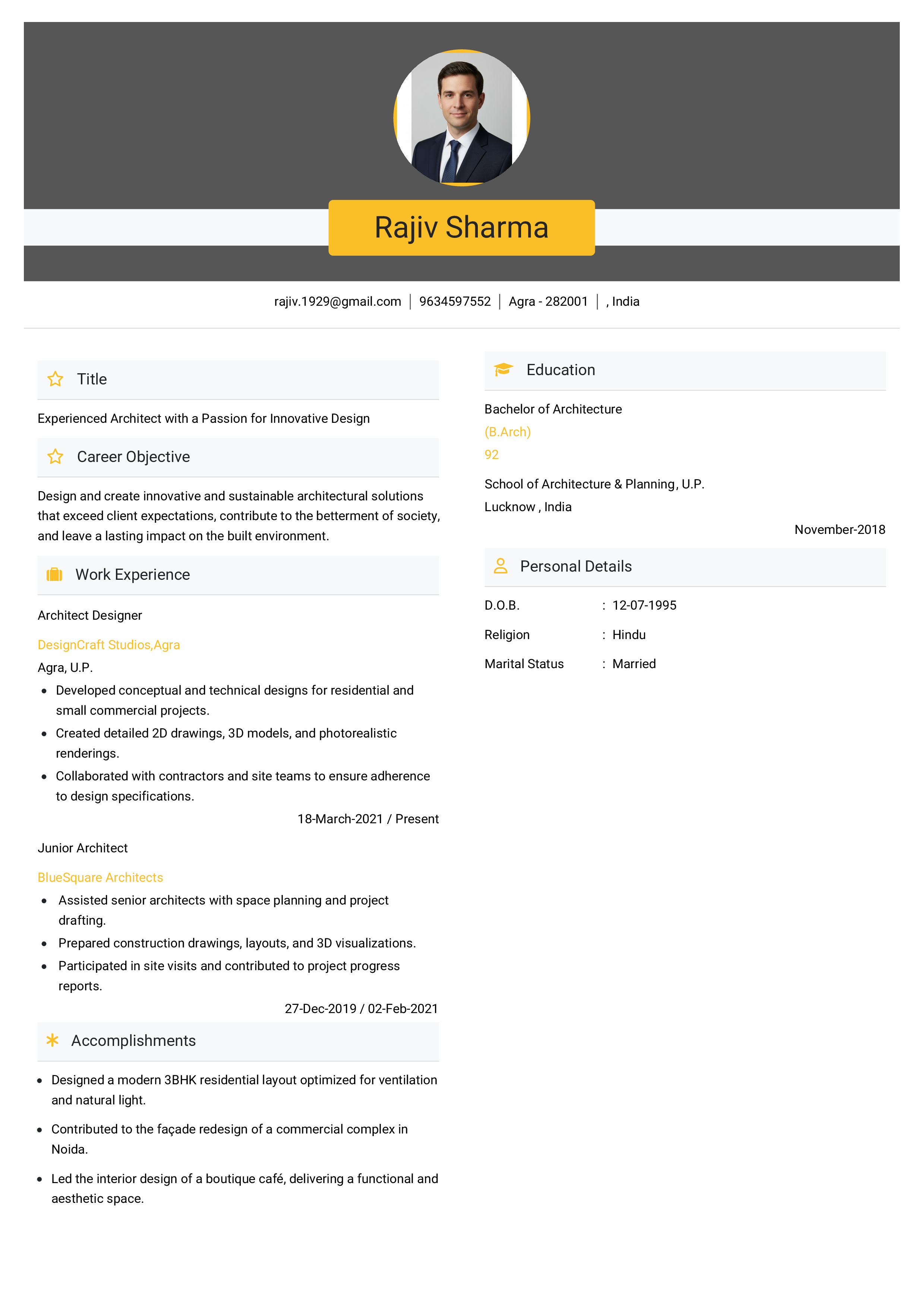
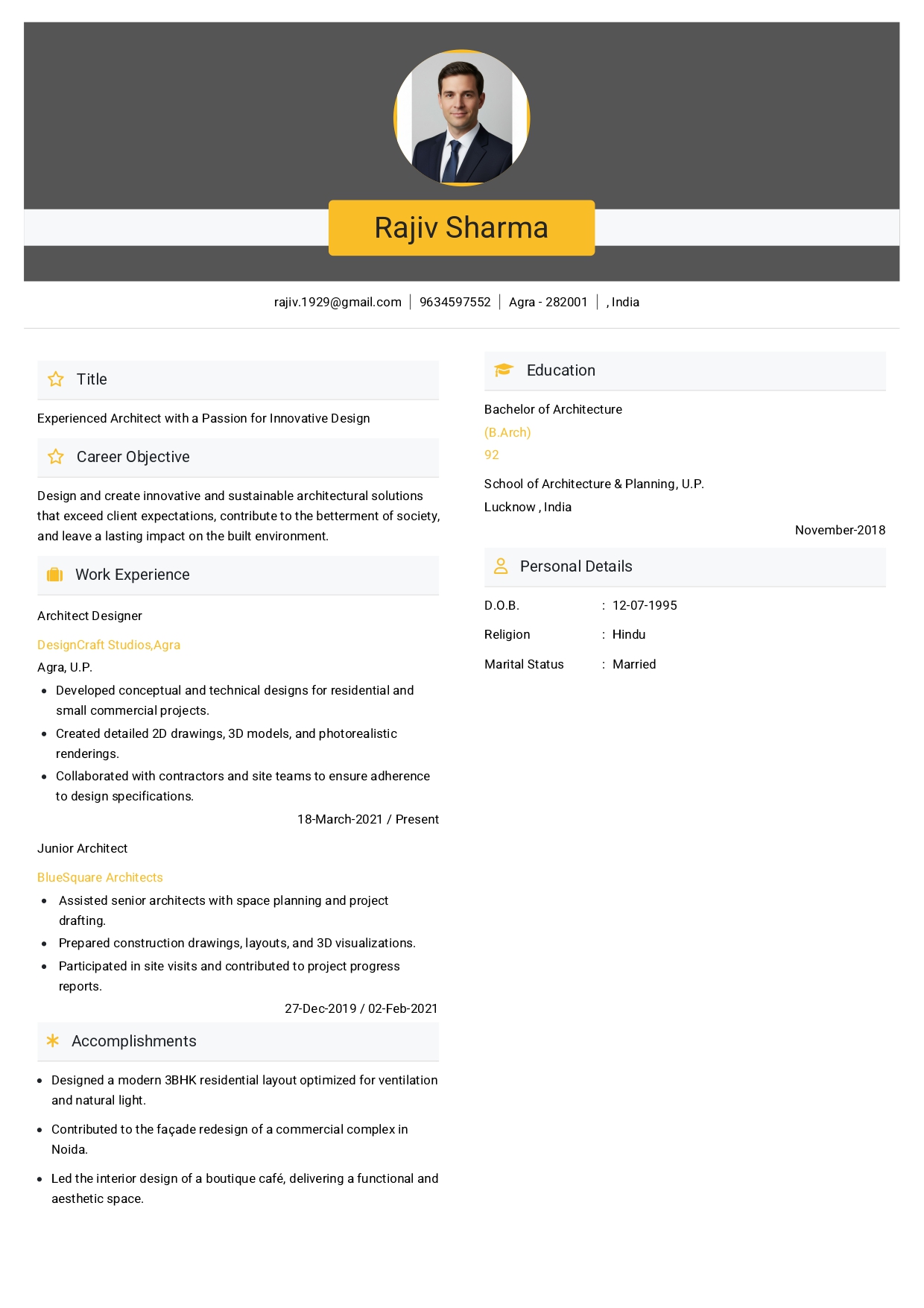
The initial aspect to consider is that your professional architect resume ought to adhere to the chronological resume format. This format is not only the most favored among recruiters globally, but it also effectively communicates your work history by emphasizing it more than other sections. After you have determined the resume format, begin to develop your resume layout, which includes the header, page length, and font size.
2. Mention your contact details
Begin by populating the content of your resume with your contact details. Although this section may seem straightforward, it is crucial to ensure that it is free of any typographical errors. Ultimately, regardless of how impressive your architect resume may be, it will be ineffective if the recruiter is unable to reach you due to an error in your phone number. Therefore, it is essential to verify all the information you submit, which should encompass:
- Name and surname
- Professional title
- Phone number
- Location (city and state/country)
- Link to an online portfolio or your professional website.
3. Write your resume summary or objective
Your resume’s professional summary or objective, serves as a concise elevator pitch for your resume. In just 2-4 sentences, it encapsulates the key aspects of your career, including your experience, accomplishments, relevant skills, and career aspirations. Depending on your level of work experience, you may choose to include either a resume summary or an objective.
The resume summary emphasizes your previous work experience while placing less focus on your goals. Typically, it highlights your years of experience, key skills, and professional achievements. Conversely, a resume objective centers more on your skill set, educational qualifications, and career ambitions, making it particularly beneficial for students who may not have extensive work experience.
4. Craft an outstanding work experience as an architect:
Your professional experience serves as the most effective means to demonstrate to recruiters that you are a qualified candidate, aside from impressing them with your previous professional accomplishments and duties. Therefore, it is essential to ensure that this section is as engaging as possible. To begin, focus on the formatting.
Commence with your most recent or current position and work your way backward. Do not include jobs from many years ago or those that are not particularly relevant to the position. The hiring manager is unlikely to be impressed by your data entry role from a decade ago. Start each entry with your job title, followed by the company name, the duration of your employment, and 3-5 of your key achievements and responsibilities, presented in bullet points.
Now the question arises: what should you include in your resume if you lack experience in architecture? Fortunately, there is no need for concern. If you are applying for a junior architect position, the recruiter reviewing your resume does not actually anticipate that you will have any prior work experience.
Instead, they are more focused on examining your portfolio and understanding your enthusiasm for the role. The positive aspect? Your portfolio is not constrained by the number of jobs you have held. In fact, you can create a quite impressive portfolio simply by incorporating elements such as:
- Academic and personal architecture projects
- Contests where you’ve participated or won
- Freelance jobs you’ve found online
5. List your academic background
The education section may not hold the same significance as the work section; however, this does not imply that it should be anything less than impeccable. Adhere to the following guidelines to create a concise and effective education section:
- Begin with your highest degree, followed by the name of the university, its location, and the years you attended.
- If you possess another advanced degree, ensure it is included in your resume as well.
- You may omit your high school diploma if you have obtained a bachelor’s degree.
For entry-level professionals, it is advisable to list any relevant academic achievements beneath each education entry to enhance your architect resume.
6. Mention your architectural skills
A well-defined architectural skills section - particularly for technical positions like architecture - is the second aspect that recruiters will observe following your work experience.
Therefore, it is essential to ensure its effectiveness by incorporating both hard and soft skills. Include only those skills that pertain to architecture and, more specifically, to the position for which you are applying.
Hard Skills
- Hand Drafting
- Sketching
- Autodesk AutoCAD
- ArcGIS
- Adobe Creative Cloud Suite
- Sketchup Pro
- Autodesk Revit
- Windows & OSX Operating systems
Soft Skills
- Presentation Skills
- Public Speaking
- Active Listening
- Perseverance
- Written & Oral Communication
- Creativity
- Problem Solving
- Critical Thinking
7. Never forget to add your licence
Licenses are typically acquired through a recognized institution. Additionally, obtaining certifications in architecture serves as an excellent means to showcase an individual's dedication. Including licenses on an architecture resume signifies a thorough understanding of industry advancements. They indicate that an architect possesses the qualifications necessary to practice architecture.
Key takeaways
- Significance of clarity: In the competitive job market of today, a clear and easily readable resume is vital, akin to a well-constructed building that harmoniously combines aesthetics and functionality.
- Resume structures: Grasping the most effective architecture cover letter structure can significantly showcase your architectural abilities and career path.
- Keyword incorporation: Developing a focused experience section rich with keywords from the job description guarantees that your resume appeals to both human reviewers and ATS.
- Measurable accomplishments: Incorporating specific metrics and measurable accomplishments, such as cost reductions or project efficiencies, offers tangible proof of your influence and effectiveness.
- Key certifications: Enumerating essential certifications and licenses, such as LEED and ARE, facilitates your resume's passage through ATS filters and illustrates your professional credentials.
Conclusion
Are you seeking additional help in creating an exceptional resume? JobsCruze AI Resume Builder offers smart content recommendations that are specifically customized to your architectural background, along with professionally crafted templates that effectively highlight your creativity and technical skills.