
Table of Contents
▼- Business Development Executives Examples & Writing Guide
- 1. Tips to properly format your business development executive resume
- 2. Resume summary or resume objective, what to choose?
- 2.1 When you should use a resume summary
- 2.2 When you should use a resume objective
- 3. How to showcase your skills on a resume
- 4. Tips for describing work experience on a resume
- 5. Boost your business development executive resume with action verbs
- 6. How to show your educational background in your resume for the BDE role
- Conclusion
Business Development Executives Examples & Writing Guide
The role of a business development executive requires strong leadership skills and a keen understanding of business, enabling these individuals to guide organizations toward growth and success. These professionals leverage their communication skills, marketing expertise, and commercial experience to enhance a company's relevance. If you are seeking a position in business development, meticulously preparing your resume can help you effectively showcase your relevant skills and qualifications to prospective employers.
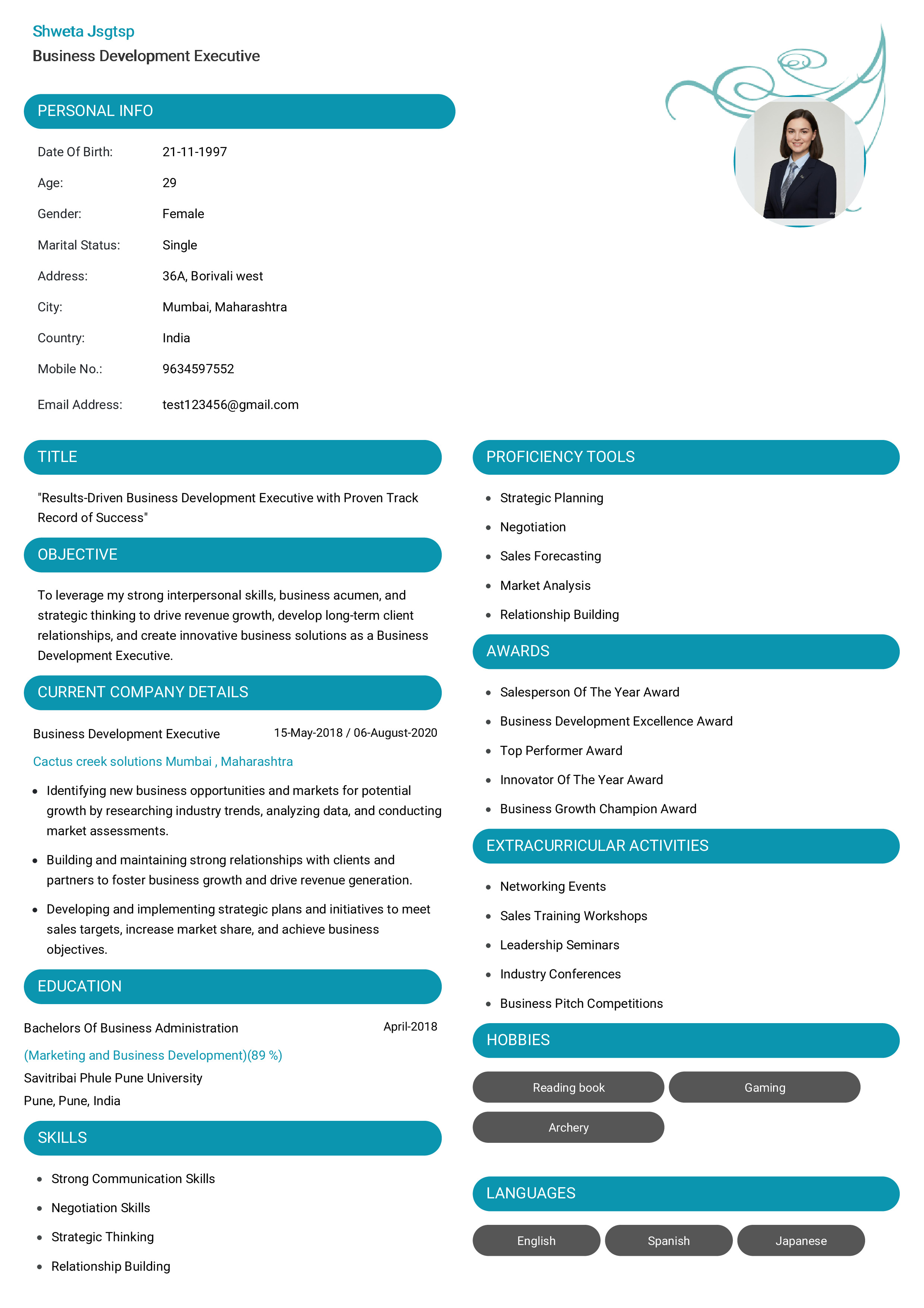
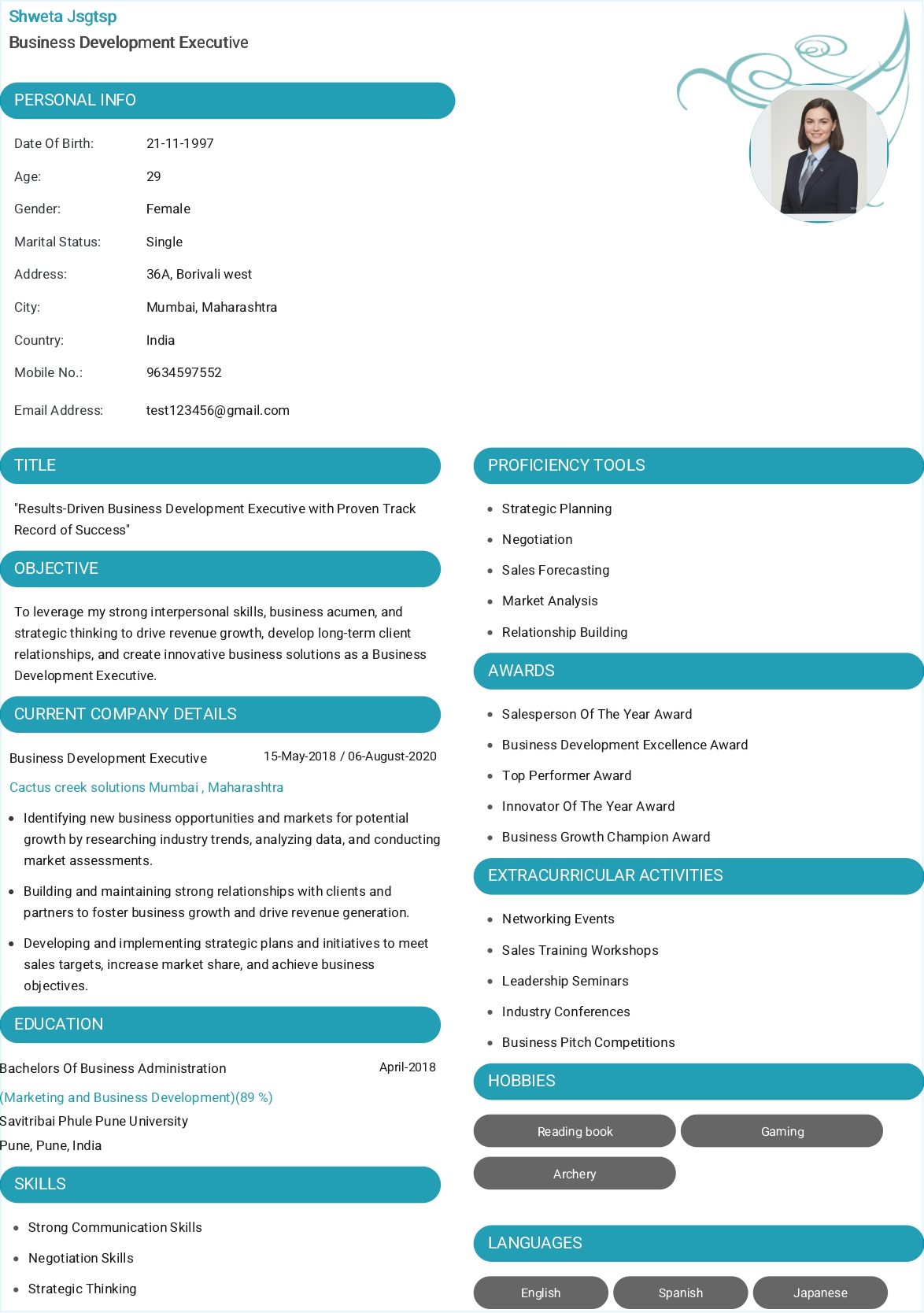
This blog will explore how can a resume best showcase an applicant, the process of creating a business development executive resume, and provide a template along with an example that you can use as a foundation for your own resume.
1. Tips to properly format your business development executive resume
So there are mainly three formats from which you can choose, and all three are different from each other, highlighting something different. Your format changes the way a hiring manager looks at your resume, so choose wisely. Let's know what they notice first.
Consider what aspects you would like employers to prioritize. Your resume ought to highlight your strengths prominently while subtly minimizing any elements that could provoke questions.
- Reverse-chronological resume: This is the most prevalent (and safest) choice, particularly if you possess a robust work history without significant gaps. This format emphasizes your employment history, listing your positions beginning with the most recent and proceeding backward. Opt for this format if you have been consistently employed in the same or a related field.
- Functional resume: A functional resume alters the focus. Rather than concentrating on your previous workplaces, it prioritizes your skills. This format can be beneficial if you are attempting to enter a new industry or if your employment history is not as seamless or pertinent. It is ideal for individuals changing careers, recent graduates, or anyone with substantial gaps in their resume.
- Combination (or hybrid) resume: This format integrates aspects from both styles. It is a versatile option that is effective if you have developed numerous transferable skills or if your work history encompasses a variety of business development executive roles and responsibilities. It highlights both your skills and your experiences. There is no singular emphasis, allowing for weaker areas to be supplemented or presented more favorably.
Selecting the appropriate resume format is not merely about choosing the most visually appealing option. It is about identifying the one that is most effective for you. If formatting your resume is not your preferred aspect of the job search, do not hesitate to explore our professionally crafted resume templates.
2. Resume summary or resume objective, what to choose?
Hiring managers don’t read every resume from top to bottom. In fact, most only skim, especially when a role gets dozens of applicants. That’s why the short section at the very top of your resume matters so much. Whether you use a business development resume summary or a resume objective, this short paragraph acts like a highlight reel. It gives hiring managers a quick “taste” of what’s to come, and also helps them decide whether to keep reading.
2.1 When you should use a resume summary
A resume summary is most effective when you possess some practical experience in business development — perhaps as a sales representative, a business development manager, or even in a client-facing position with notable achievements.
Your summary ought to encompass:
- Job title or role (for instance, Business Development Manager, Sales Executive)
- The number of years of experience you have accumulated
- Essential skills (such as lead generation, client relationship management, or CRM software)
- A selection of quantifiable successes (such as revenue growth, acquisition of new clients, or significant deals finalized)
2.2 When you should use a resume objective
A resume objective is the preferred option if you are beginning your journey in business development, changing careers, or returning after a hiatus. Rather than emphasizing previous employment, you aim to highlight your potential.
An effective objective should encompass:
- Your career aspiration (for instance, "to advance into a client-facing sales position")
- Your most pertinent skills or training
- What qualifies you as a suitable candidate for the role, even in the absence of extensive experience
- An indication of your work ethic or drive
3. How to showcase your skills on a resume
If there is one aspect that can determine the success or failure of a business development resume, it is the process of tailoring. It may be alluring to enumerate every skill you have acquired throughout the years. Indeed, you likely possess a diverse range of abilities. However, crafting a resume that effectively secures interviews is not merely about showcasing all that you are capable of. It is fundamentally about demonstrating that you are the candidate they seek.
Want to determine which skills to highlight?
- Begin by examining the job description. Start with this step. Identify the business development executive skills in resume that are explicitly mentioned. They are typically found under the sections labeled "requirements" or "preferred qualifications." Take note of those that are repeated, as they are likely essential.
- Next, compare this list with your own experience. Now, assess your own skill set. Which of your abilities align with the job's requirements? That intersection represents your area of strength.
- Finally, establish a distinct skills section. Create a separate section titled "Skills" on your resume. Position your most pertinent, job-specific skills at the top of this list. This approach facilitates easy identification for both recruiters and applicant tracking systems, highlighting what is most significant.
Here are some skills that are most in demand for a business development executive role-
Top hard skills
- Market research and analysis
- B2B sales strategy
- CRM tools
- Strategic partnership building
- Pipeline management
- Cold calling and cold emailing
- Data tracking and reporting
Top soft skills
- Emotional intelligence
- Resilience
- Relationship building
- Time management
- Active listening
- Problem-solving
4. Tips for describing work experience on a resume
Similar to your skills section, your work experience section should not be a generic list. It must be customized according to the job advertisement you are applying for. Concentrate on parts such as "Requirements" or "You will be responsible for." This is where employers specify precisely what they seek in their next employee. Take note of the skills and responsibilities that are frequently mentioned.
Follow the formula for a robust work summary.
- Begin with your job title, the name of the organization, and the location.
- Include your employment dates (the month and year format is the standard).
- Utilize bullet points to outline your primary responsibilities and achievements.
- Emphasize results rather than merely listing duties.
- Support your statements with numerical data or metrics whenever feasible.
- Initiate with action verbs.
5. Boost your business development executive resume with action verbs
Do you wish to enhance your resume with an added touch of clarity and confidence? Here is a reliable technique: utilize action verbs. By avoiding a passive or ambiguous tone, you will present yourself as an individual who takes initiative, achieves results, and accomplishes tasks. Beginning each bullet point with the same word can lead to monotony. Even if you employ powerful verbs, the repetition can render your resume uninspiring. Aim to vary the verbs you use to illustrate your impact from different perspectives (such as strategic, collaborative, results-oriented, etc.).
Action verbs to incorporate in a business development resume
- Prospected
- Negotiated
- Closed
- Generated
- Expanded
- Pitched
- Identified
- Secured
- Accelerated
- Streamlined
6. How to show your educational background in your resume for the BDE role
Does the education section hold significance if you have been engaged in business development for some time? Or if your degree does not explicitly convey "sales strategy and management"?
The brief answer is: yes, it is indeed significant. Nonetheless, the manner in which you showcase your education largely depends on your personal history and your current career stage. Below are guidelines for addressing each scenario
Option 1: Your degree may not be directly associated with business development.
Perhaps you pursued studies in literature, psychology, or an entirely different discipline before transitioning into business development. This is perfectly acceptable. A degree in a different area still conveys several significant messages to potential employers:
- You demonstrate the ability to commit to a task and see it through to completion.
- You have honed your skills in communication, analysis, or research.
- You have managed deadlines, collaborated in group settings, and tackled demanding coursework.
Option 2: Your degree is pertinent to business development. If you pursued studies in business, economics, marketing, communications, or any related field, this presents a prime opportunity to demonstrate how your education has established a foundation for your current skill set.
In this instance, delve deeper than the fundamentals. Incorporate:
- Relevant coursework
- Projects or case studies
- Business competition or clubs
- Academic achievements
- Internship undertaken during your academic tenure
- Mistakes that might make your resume look like a mess
You have dedicated time to creating a resume that highlights your skills, experience, and potential. Excellent. However, before you begin distributing it, take a moment to ensure it does not contain any concealed red flags that could jeopardize your opportunities. Even the most seasoned candidates can become victims of these frequent resume mistakes:
- Typing mistakes, grammatical errors, and ungraceful language
- A ‘one-size-fits-all’ resume’
- Showcasing responsibilities but not outcomes
- Job description without keywords
- Unorganized resume structure
- Adding irrelevant fillers
Conclusion
The most challenging aspect of crafting your resume is the initial step, and now you are prepared to invest the effort required to secure your ideal business development executive position. Advance your career with a resume that distinguishes you from the competition. Utilize the JobsCruze Resume Builder to swiftly craft a refined, ATS-compatible resume within minutes. Click here to construct your professional resume today and enhance your likelihood of securing employment with JobsCruze!