




Table of Contents
▼- Photographer Resume Example & Writing Guide
- Steps to create a resume for a photographer
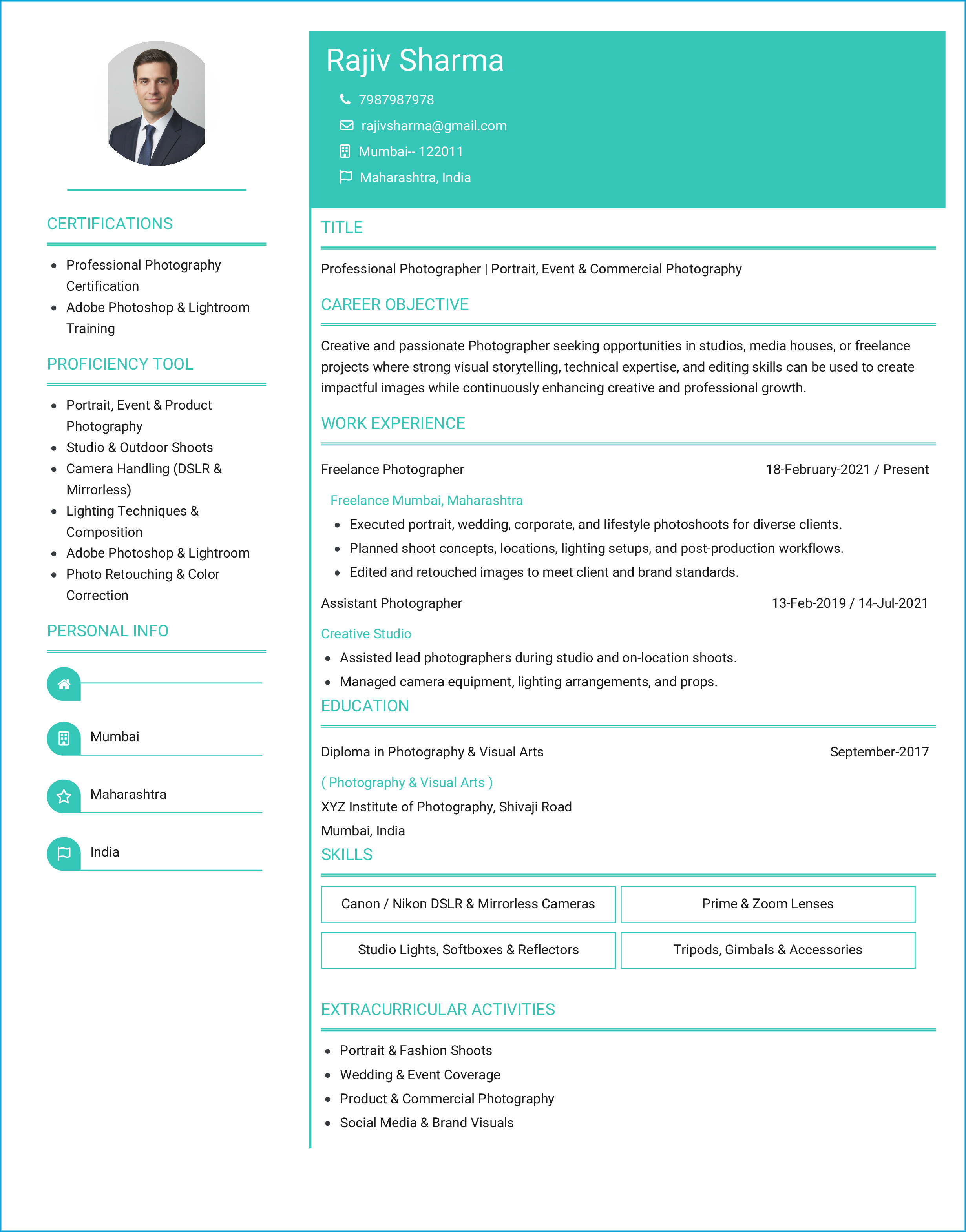
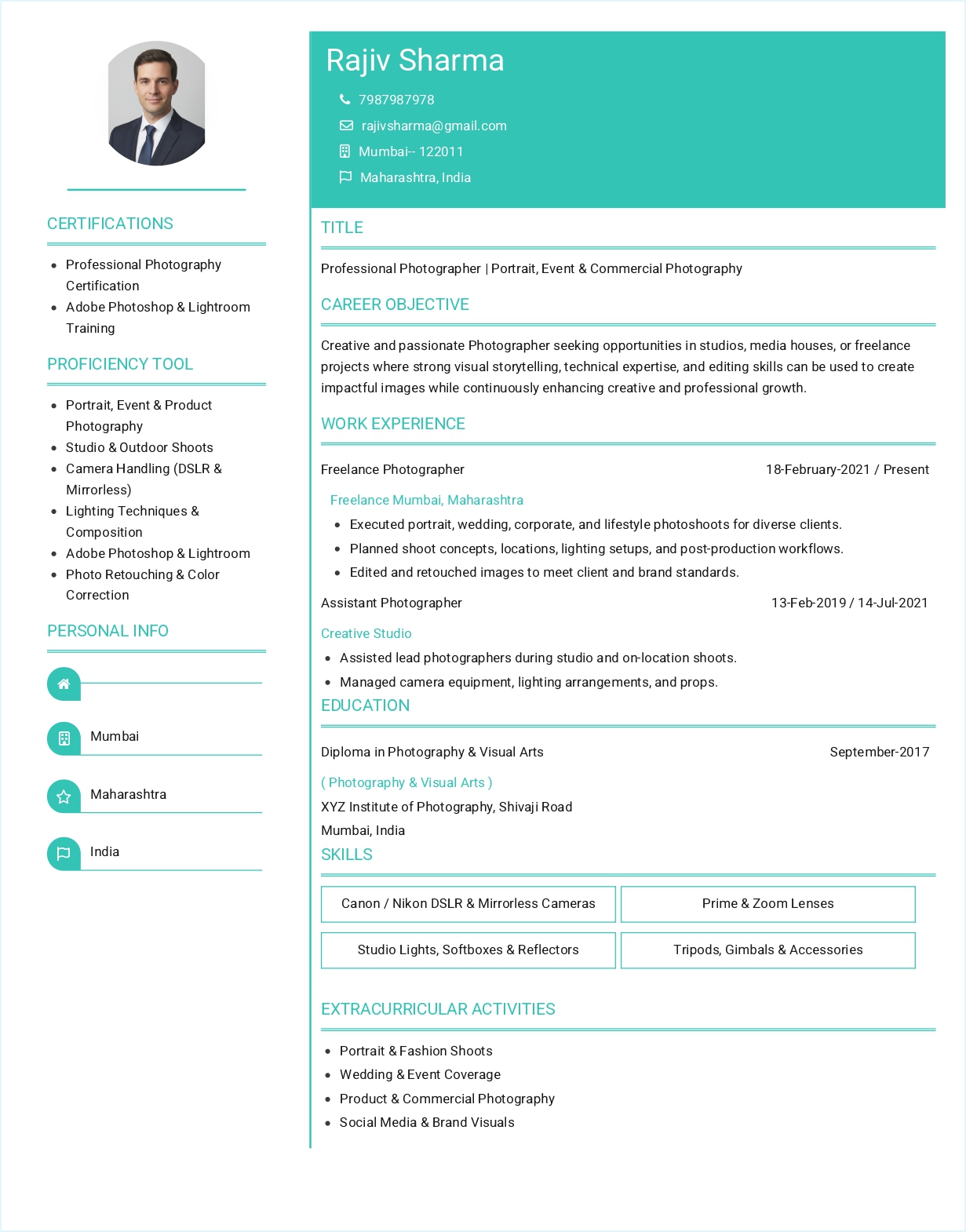
- 1. Create an interesting resume summary or objective
- 2. Tell about your work experience
- 3. Include your qualifications
- 4. Include your training and certifications
- 5. Showcase your achievements and awards
- 6. Never forget to mention your skills
- 7. Add your contact details
- Why include a cover letter?
- Some more sections you can add in your resume.
- FAQ’s Photographer Resume
- Q. Is it advisable to add a photograph to my photographer's resume?
- Q. How can I effectively include keywords in my photography resume?
- Q. What should I refrain from adding to my fresher photographer resume?
- Q. What is the most effective method for addressing employment gaps on my photography resume?
Photographer Resume Example & Writing Guide
Every exceptional photographer requires a resume that irresistibly conveys their skills and experience. Given the fierce market competition, it’s vital to capture recruiters' attention instantly. And while your portfolio is needed for that, you also need a captivating professional photographer resume to guide the recruiter there. This is why we have created a comprehensive guide that takes you through the entire process, step by step. With our practical examples, authentic photographer resume samples, and professional templates, you will have your resume prepared in no time.
Steps to create a resume for a photographer
1. Create an interesting resume summary or objective
The first step in crafting an attractive resume is to write a strong summary in the beginning. Think of it as your professional pitch. Include your career history and credentials while outlining your aspirations and goals. The best way to do that is to highlight your goals that will benefit the organization and explain the steps you will take to achieve them to the recruiter.
2. Tell about your work experience
If you are a fresher, you can include your internships during your education. For freelancers, this section will highlight all their previous assignments. You have already included your portfolio, so here list of your clients and the timeframe for each assignment. And if you are simply changing the place of work, include the name, job title and period you were there at previous organizations.
3. Include your qualifications
Frequently, employers seek candidates who possess a specific level of education, such as an undergraduate degree or a diploma. Regardless of whether you graduated in a different field, it is crucial to highlight your educational qualifications in your resume. Make sure to add the program's name, the school you attended, your graduation year, and the institution's location.
4. Include your training and certifications
There are very few degrees that specifically target photography courses. So, this section is essential for you. Include all the extra courses that can boost your photography expertise. This not only shines a light on your capabilities but showcases your enthusiasm as well.
A specialized certification in either editing or a hands-on course can prove to the recruiter that you have the required skill. In your resume, be sure to specify the name of your certification, the certifying authority, the year you obtained the certification, and its validity, if applicable. This information informs the recruiter about the quality and relevance of your training.
5. Showcase your achievements and awards
It is essential to highlight your awards and accolades on your resume, as this indicates to the recruiter that you possess expertise in your field. This will help the recruiter identify your strengths. Furthermore, you can even include recommendations from previous work as it will give your resume more credibility.
6. Never forget to mention your skills
Establish a segment in which you outline your abilities and strengths as a photographer. This allows the recruiter to comprehend your competencies and allocate projects to you appropriately. Additional skills that you may wish to incorporate into your resume include creativity, adaptability, and attention to detail, teamwork, and interpersonal skills. Should you possess expertise in utilizing any equipment necessary for photography or editing, it would be beneficial to highlight that as one of your strengths.
7. Add your contact details
Right at the beginning of your creative photographer resume, ensure that your contact details are present, allowing a recruiter to reach out to you if they find your profile appealing. Include your complete name, residential address, telephone number, and email address. You can also link your online portfolio, so that the recruiter can see and judge your work and its quality.
Why include a cover letter?
You may be questioning whether cover letters hold any significance when applying for a job. The concise answer is affirmative. They are indeed very important. Cover letters remain essential to your job application, and failing to include one could diminish your chances of securing an interview. By composing a photographer resume cover letter, you demonstrate to the hiring manager that you have a genuine interest in this particular position, rather than merely distributing a generic resume indiscriminately. Now, we understand your concern – you are a photographer, not a writer. Although a picture conveys a thousand words, the thought of articulating those words does not appeal to you. Thankfully, we have some cover letter advice that will assist you in crafting a cover letter that complements your resume, with minimal effort.
Some more sections you can add in your resume.
-
Hobbies are pursuits that you take pleasure in during your leisure time. They can demonstrate that you possess interests beyond your professional life. For instance, if a photographer enjoys outdoor activities like hiking or camping, this may suggest a readiness to travel for work.
-
Courses can signify your proficiency in the industry. Enrolling in photography-related classes indicates that you are dedicated to refining your skills and keeping up with the latest trends in photography.
-
Languages can be a valuable addition to a best photographer resume, as numerous clients seek photographers who are proficient in multiple languages. Being multilingual can create opportunities for international projects and partnerships. It can also assist you in establishing connections with clients from various countries.
-
Awards can serve as evidence of your accomplishments in photography. If you have been honoured by the industry for your excellence, this should be highlighted on your photography resume.
-
Internships can offer significant experience and aid in the development of new skills.
- References can provide an impartial evaluation of your abilities. Including letters of recommendation in your photography portfolio implies that others have confidence in your talents.
FAQ’s Photographer Resume
Q. Is it advisable to add a photograph to my photographer's resume?
A. Adding a photograph to your resume is not essential. In certain countries, it may even be perceived as unprofessional or distracting. It is prudent to verify in advance. When determining whether to include a photo, one must take into account the industry standards and geographical location.
Q. How can I effectively include keywords in my photography resume?
A. Begin by thoroughly reviewing the job advertisement and identifying any essential technical skills or qualifications that are highlighted. Subsequently, seamlessly weave these keywords into your resume. For instance, if the job listing specifies "photo retouching" and "studio lighting," ensure that these phrases are incorporated into your resume in appropriate contexts.
Q. What should I refrain from adding to my fresher photographer resume?
A. Refrain from including unrelated personal details, such as your age, marital status, or extensive hobbies, unless they pertain directly to photography. It is essential to maintain a professional tone in the resume and concentrate on how your skills and experiences position you as the perfect candidate for the role.
Q. What is the most effective method for addressing employment gaps on my photography resume?
A. The essential approach is to present this gap positively. If you took a break to concentrate on personal projects, consider portraying this time as a fruitful pursuit. For instance, you might emphasize your efforts in creating a personal portfolio and enhancing your retouching abilities. Additionally, you can mention any certifications or courses you have completed.