




Table of Contents
▼- English Teacher Cover Letter Example & Writing Guide
- Why is an English Teacher Cover Letter Necessary?
- English teacher cover letter writing steps
- Common errors to steer clear of in a cover letter
- Cover letter FAQ’s
- Q. What is the ideal length for a cover letter?
- Q. Is it necessary to write a cover letter?
- Q. Should you incorporate examples in an english teacher cover letter?
- Q. Is it permissible to compose a basic generic cover letter?
English Teacher Cover Letter Example & Writing Guide
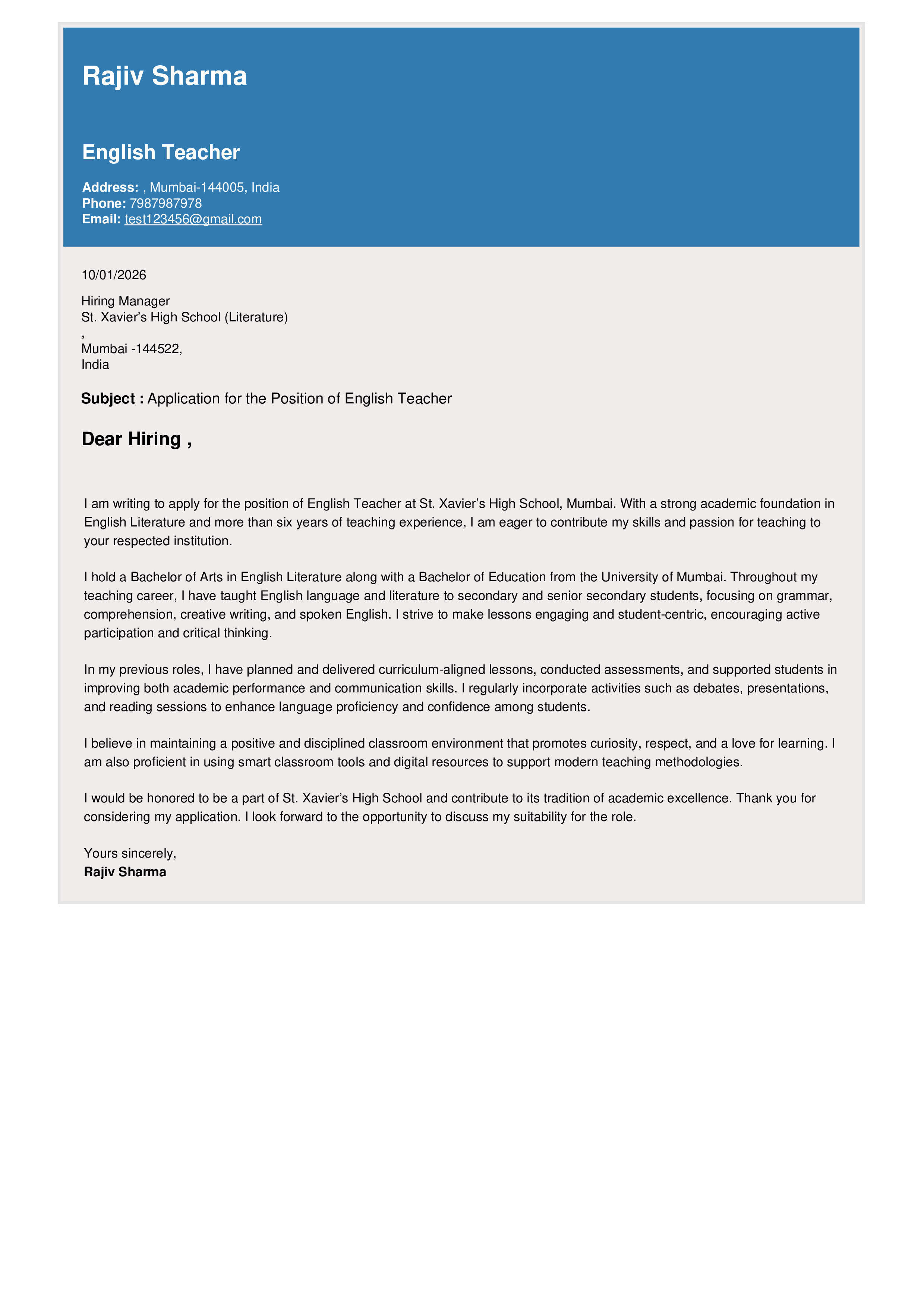
Crafting a compelling cover letter involves more than merely summarizing your resume. For English Teachers, it serves as a platform to exhibit your proficiency in language, your capacity to engage and motivate, and your enthusiasm for teaching. The layout of your cover letter is vital in this context. A well-organized Cover letter for English Teacher with experience not only captures the interest of hiring managers but also highlights your skill in organizing ideas and communicating clearly; essential qualities for any effective English Teacher.
If you are seeking a method to distinguish yourself from others when applying for English teaching positions, crafting an exceptional cover letter is essential for creating a powerful first impression. This english teacher cover letter writing guide will furnish you with all the necessary information to compose an impactful cover letter that will capture the attention of prospective employers.
Why is an English Teacher Cover Letter Necessary?
- An English Teacher cover letter serves as a crucial document that offers schools a comprehensive summary of your qualifications and experience.
- It is the initial item that a school will review when evaluating your application for a teaching role, providing you with an opportunity to differentiate yourself from other candidates.
- A meticulously crafted cover letter will help you capture the attention of employers and illustrate why you are the most suitable candidate for the position.
- Your cover letter ought to emphasize the skills and experiences pertinent to the role, along with any unique qualifications or certifications you possess.
English teacher cover letter writing steps
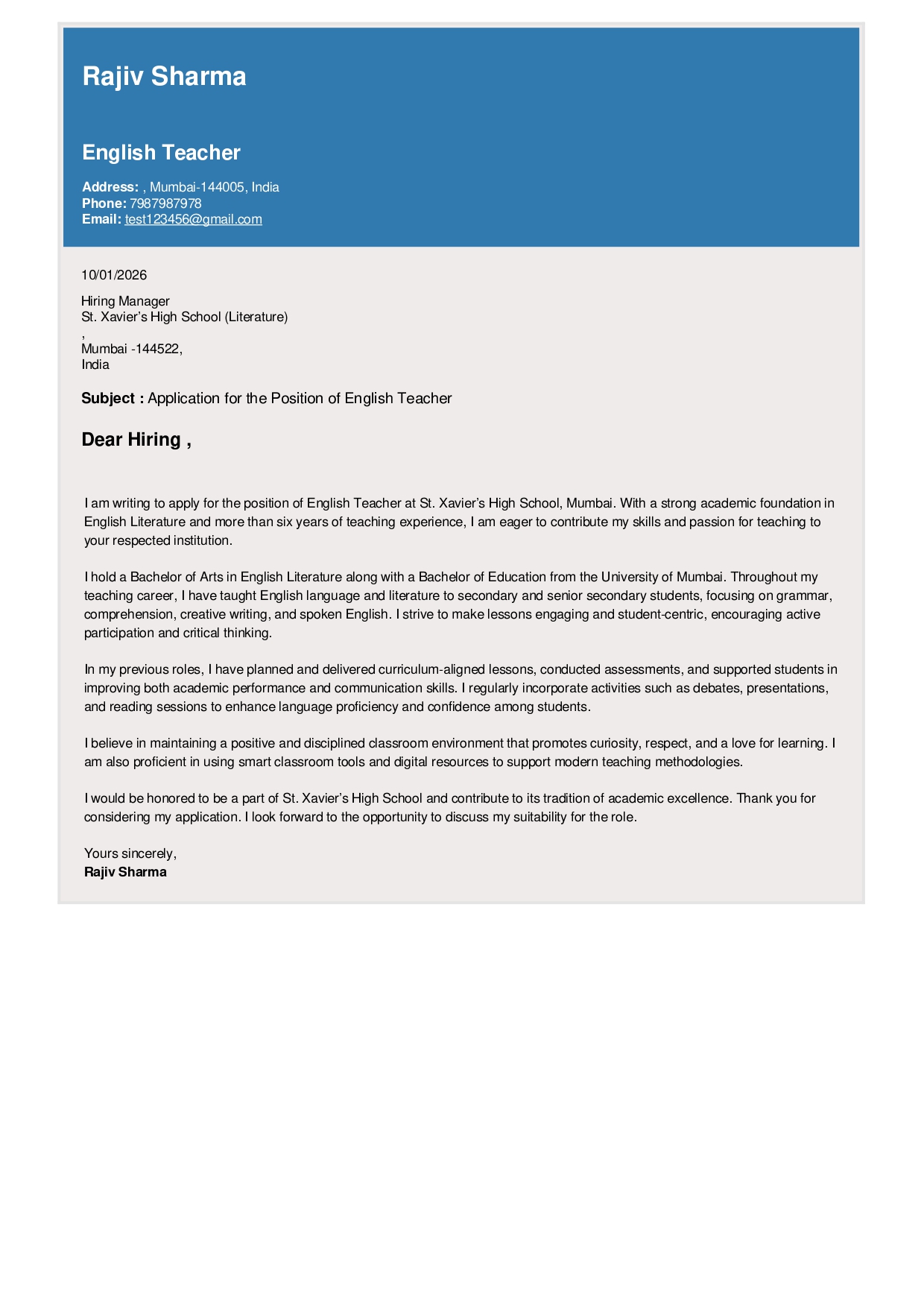
1. Create a header
Similar to formal letters, start by including a header. The header should contain your name, degree, phone number, email address, city of residence, and the date. This allows recruitment managers or head teachers to reach out to you if they have inquiries or wish to follow up on your application. If available, provide your professional contact details, as this assists in distinguishing between personal and business calls, enabling you to respond appropriately. Regularly check your calls and inbox to ensure you can reply promptly to messages from recruiters.
2. Write an introduction
Beneath the header, direct the letter to the hiring manager or utilize the recipient's name if it is known. The name of the hiring manager or head teacher can often be located on the school's website or within the job description. Begin by introducing yourself and stating the purpose of your letter. Convey your enthusiasm regarding the job opportunity, explain your preference for this school compared to others, outline your motivations for applying, and describe how this position corresponds with your career goals.
3. Describe your motivations
Effectively communicating your motivations can significantly enhance your chances of securing employment, as it demonstrates your enthusiasm and dedication to teaching, as well as your reasons for wanting to join a specific employer. It is advisable to research the educational institution to which you are applying, allowing you to tailor your motivations and express authenticity, for instance, by investigating and referencing the institution's rating. Below are some questions to consider when reflecting on your motivations:
- What draws you to this institution compared to other schools in the vicinity?
- How does securing this position align with your professional aspirations?
- What strategies do you intend to implement to benefit learners positively?
- What is your understanding of the institution's standing in the community?
- Do you find the school's values to be in harmony with your own?
4. Emphasise your candidacy
In the primary section of the letter, highlight your candidacy by detailing your pertinent teaching experience and qualifications, while avoiding a verbatim repetition of your CV. Summarize your credentials, including a bachelor's degree in English and a teaching certification, along with your professional background as an English teacher. Cite instances of your most notable achievements in previous positions, providing data and evidence whenever feasible to demonstrate the magnitude of your successes. Include your essential core teaching skills, such as:
- proficiency in classroom management
- outstanding verbal and written communication skills
- strong leadership abilities
- A comprehensive understanding of the English language and literature
- grasp of learning theories
5. Add a call to action
A call to action cover letter is a persuasive writing strategy aimed at encouraging a particular response from the reader, such as returning a call or giving an update regarding the application. Employ a straightforward and approachable call to action, such as Please feel free to reach out to me if you have any questions or wish to discuss my application further. Indicate your preferred method of contact or advise the reader to utilize any of the contact information you have provided. Lastly, express your gratitude for their consideration of your application.
6. A sign off with a valediction
A valediction serves as a formal farewell and is an essential element of formal correspondence, including letters and cover letters. Employ a valediction like 'sincerely' or 'kind regards,' followed by your name or signature beneath it. Prior to submitting your application and cover letter, ensure to proofread the document to identify any spelling or grammatical errors, as these can diminish the quality of the letter and adversely affect your application. Additionally, consider asking a friend or colleague to review the letter for the same purpose.
Related: Click here to construct your professional cover letter today and enhance your likelihood of securing employment with JobsCruze!
Common errors to steer clear of in a cover letter
- Employing a generic cover letter
- Overloading with technical jargon
- Failing to customize the letter for the specific job and company
- Not emphasizing accomplishments
- Overlooking the proofreading process
Cover letter FAQ’s
Q. What is the ideal length for a cover letter?
A. A cover letter ought to be limited to one page or less, consisting of no more than three to four paragraphs. Aim for approximately 250-500 words, which should include an introduction, one or two body paragraphs that emphasize your skills and achievements, and a concluding paragraph. For further advice and insights on the ideal length of a cover letter, consider exploring additional resources. Maintaining clarity and conciseness allows hiring managers to swiftly recognize your suitability for the position without being inundated by an excessively lengthy letter.
Q. Is it necessary to write a cover letter?
A. In the majority of situations, the answer is affirmative—a cover letter remains a significant component of a job application. It provides an opportunity for you to present yourself, emphasize accomplishments that may not be easily included in your resume, and clarify why you are an excellent fit for both the position and the organization.
Q. Should you incorporate examples in an english teacher cover letter?
A. Indeed, incorporating examples in your cover letter for an english teacher position is among the most effective methods to showcase your qualifications. Rather than merely enumerating skills, provide concise, specific examples that illustrate how you have utilized those skills in actual scenarios.
Q. Is it permissible to compose a basic generic cover letter?
A. It is advisable to refrain from using generic cover letters whenever feasible. Hiring managers prefer to observe that you have invested effort in customizing your letter for the particular position and organization. A generic letter may appear impersonal and could diminish your likelihood of distinguishing yourself.
