




Table of Contents
▼- Structural Engineer Cover Letter Examples & Writing Guide
- What should you concentrate on to make your cover letter stand out?
- 1. Cover letter header
- 2. Cover letter greeting
- 3. Cover Letter Introduction
- 4. Cover letter body
- 5. Cover letter closing
- Why is a Structural Engineer Cover Letter Necessary?
- Cover letter mistakes to avoid
- Structural Engineer Cover Letter FAQ’s
- Q. What constitutes the optimal format and length for a cover letter intended for a structural engineer?
- Q. What essential skills ought I to highlight in my cover letter for a structural engineering position?
- Q. What strategies can I employ to ensure my cover letter for structural engineer job is distinctive?
Structural Engineer Cover Letter Examples & Writing Guide
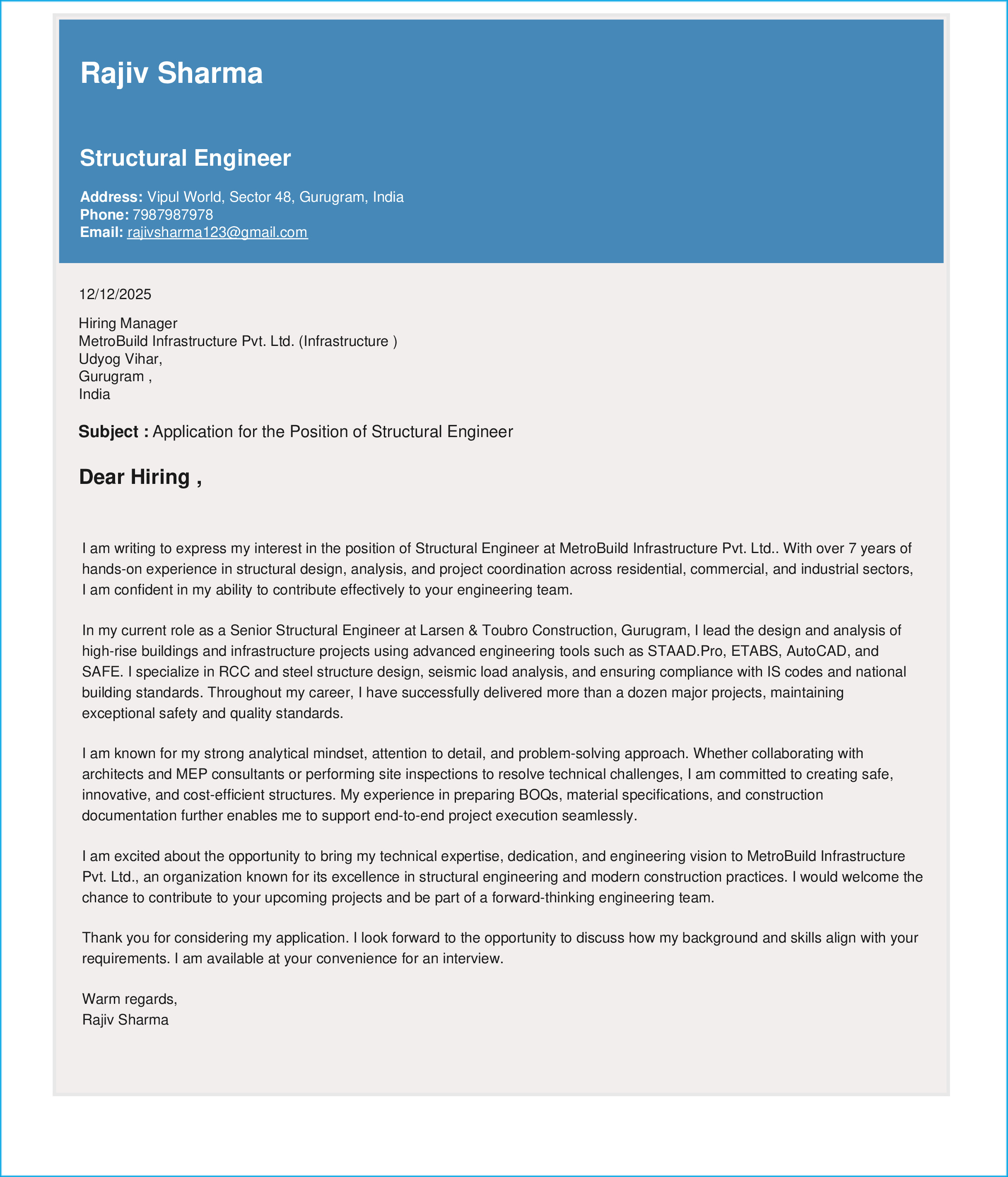
As you pursue positions as a structural engineer, you might observe that the job descriptions require candidates to possess significant training and experience. Engineering and construction companies are discerning in their hiring practices to guarantee that they recruit qualified individuals capable of employing innovative strategies and enhancing public safety. Utilizing cover letter and resume examples to refine your own application can assist you in showcasing your expertise and furthering your career.
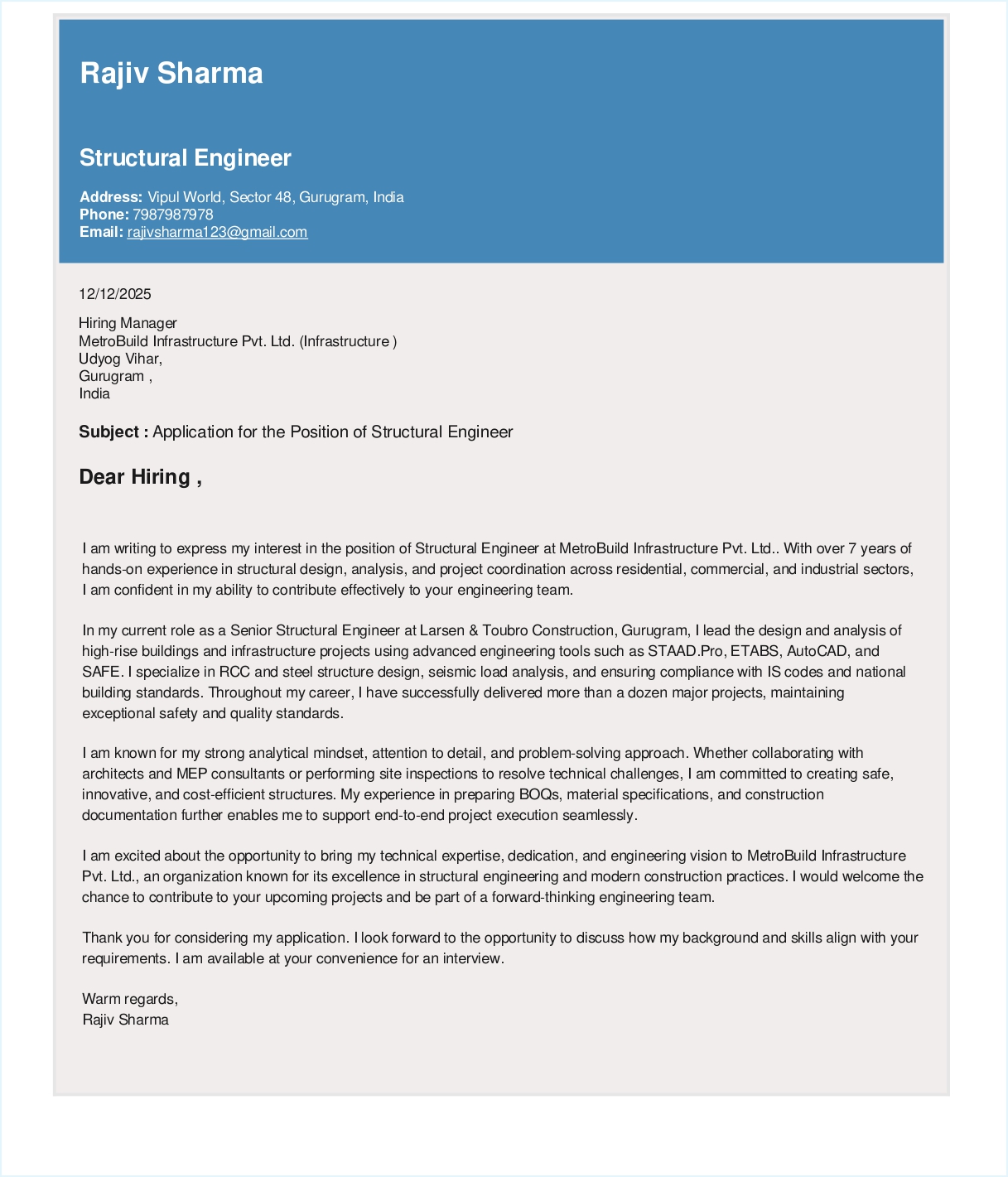
In this article, we detail the process of crafting a cover letter for structural design engineer, along with a sample for your reference. When you are prepared, you have the option to upload a resume file or create a resume using JobsCruze to apply for available positions.
What should you concentrate on to make your cover letter stand out?
1. Cover letter header
A good cover letter header is both professional and clear. Make certain that your contact details are current and precise. Refrain from using unprofessional email addresses; rather, choose an email that incorporates both your first and last name. It is important to note that the header should not contain extraneous personal information like your age or marital status. Maintain a concise, professional tone that is pertinent to your job application.
2. Cover letter greeting
As a professional structural engineer, precision and meticulous attention to detail are essential components of your profession. Demonstrate these attributes in your cover letter salutation by addressing the hiring manager with their correct title and surname, for instance, "Dear Mr. Smith" or "Dear Dr. Johnson". If you are unable to locate the name of the hiring manager, refrain from using generic salutations like "To whom it may concern". Instead, opt for a job-specific greeting such as "Dear Hiring Manager for Structural Engineering Position". This indicates that you have made a concerted effort to customize your application for the specific role.
3. Cover Letter Introduction
The introduction of your cover letter should convey not only your enthusiasm for the position but also emphasize your technical abilities and experiences that position you as a compelling candidate. Begin by referencing a significant project or achievement that demonstrates your engineering expertise. Be precise and succinct, concentrating on the effects of your contributions. Keep in mind that the objective is to captivate the reader's interest and encourage them to discover more about you.
4. Cover letter body
The main focus of your cover letter should be on your technical expertise, project experiences, and problem-solving skills. Emphasize particular projects where you implemented engineering principles to design, analyze, and supervise the construction of structures such as buildings or bridges. Elaborate on how you utilized software tools like AutoCAD or SAP2000 to develop structural designs. Additionally, it is essential to highlight your soft skills, including communication and teamwork, as these are also crucial in a collaborative discipline like engineering.
5. Cover letter closing
Structural Engineers ought to emphasize their passion for the position and the contributions they can offer to the organization. It is important to showcase your essential skills and experiences that position you as a suitable candidate for the role. Additionally, ensure that you incorporate a call to action, such as conveying your enthusiasm to further discuss your qualifications in an interview. Keep in mind that the conclusion should provide the hiring manager with a favorable impression of you, along with a clear insight into your enthusiasm and preparedness for the role.
Why is a Structural Engineer Cover Letter Necessary?
-
The cover letter of a Structural Engineer is important as it allows the candidate to highlight their pertinent experience and skills.
-
It provides the candidate with the opportunity to craft their application according to the specific job requirement and illustrate why they are the most suitable candidate for the structural engineer role.
-
A meticulously crafted cover letter can highlight the candidate's accomplishments and clarify how they can contribute positively to the organization.
-
It presents an opportunity to convey enthusiasm for both the designation and the organization, helping the candidate to leave a lasting impression on the hiring manager.
- In conclusion, a Structural Engineer cover letter can assist the candidate in distinguishing themselves from other applicants and improve their likelihood of confirming an interview.
Cover letter mistakes to avoid
- One frequent mistake that Design Structural Engineers commit when crafting their cover letter is avoiding emphasizing their pertinent skills.
- Another error is the failure to tailor the cover letter for the specific job and organization.
- Although it is important to showcase your technical skills and expertise, inundating your cover letter with too much technical terminology can deter hiring managers who may be from an engineering background too.
- Mistakes in spelling and grammar can give a sense of negligence and a lack of meticulousness, qualities that are unwanted in a Structural Engineer.
Structural Engineer Cover Letter FAQ’s
Q. What constitutes the optimal format and length for a cover letter intended for a structural engineer?
A. The structure of a good cover letter should be limited to one page, comprising 3-4 paragraphs. It is advisable to utilize a formal business letter format, beginning with your contact information at the top, followed by the date and the details of the employer.
Q. What essential skills ought I to highlight in my cover letter for a structural engineering position?
A. Highlight technical competencies, including expertise in structural analysis software, familiarity with building codes and regulations, experience with diverse construction materials, and capabilities in project management.
Q. What strategies can I employ to ensure my cover letter for structural engineer job is distinctive?
A. To enhance the uniqueness of your cover letter, incorporate detailed examples of projects you have undertaken, quantify your accomplishments whenever feasible, and showcase your understanding of the company and its initiatives.
